
The Netherlands-Israel Investment Files
How the Netherlands became Israel’s investment clearing house
Since the beginning of Israel’s genocide in Gaza, Israeli companies have seen their stock prices soar(opens in new window) . While Gaza lies in ruins, the Tel Aviv Stock Exchange reported an “all-time record”(opens in new window) for dividend payouts by Israeli stock-listed companies in 2025. In one year, a total of NIS 40.8 billion (ca. €12 billion) was disbursed to shareholders. This surpassed the previous record set in 2024.
It is not possible to assess the financial success of Israel’s largest corporations without considering the role of the Netherlands.
The Netherlands is the biggest destination for Israeli capital in the world. In 2024 (the latest year for which figures(opens in new window) are available), the Netherlands received nearly four times as much Israeli investment as the US, a whopping €44.9 billion. The financial ties go both ways. The Netherlands is the second biggest global investor into Israel. In 2024, Dutch foreign direct investment (FDI) to Israel was €27.3 billion(opens in new window) . Only the US invested more.
None of this is accidental. It is the result of Dutch policy.
For decades, the Dutch state has been one of the most aggressive countries in the world when it comes to attracting foreign capital. It offers a range of tax advantages and a vast network of treaties that strongly favour and protect investors.
The Netherlands and the EU have so far refused to use their deep economic ties with Israel as leverage to stop Israel’s crimes of occupation, genocide and apartheid. These Files show that, far from sanctioning, the Netherlands is in fact facilitating the Israeli economy.
About this series
‘The Netherlands-Israel Investment Files’ shed light on how this works: how Israeli companies use the Netherlands as an investment hub, and how foreign companies can use the Netherlands as a base for investment into Israel.
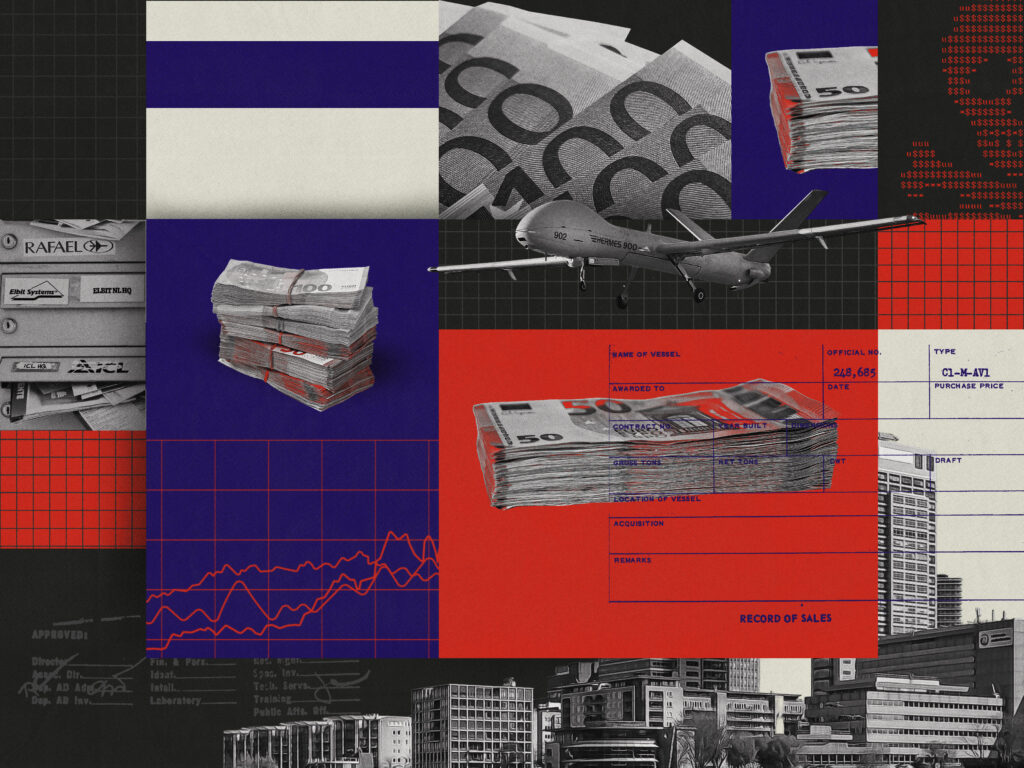
The companies highlighted in the Netherlands-Israel Investment Files are only a sample of the wide range of corporate entities that use the Netherlands to facilitate investment to and from Israel. The six profiled companies cover key sectors and show different aspects of how the Dutch system works.
What the files reveal
- File 1 provides an overview of Netherlands-Israel investment statistics and how the Dutch system operates to attract foreign and Israeli capital.
- File 2 covers Rafael Advanced Defense Systems and Elbit Systems, two of Israel’s biggest arms companies, which use the Netherlands as a base to hold their European subsidiaries.
- File 3 focuses on two major cybersecurity companies: the Israeli firm Check Point Software and the US company Palo Alto Networks. Check Point uses a Dutch company to hold its international investments. Palo Alto Networks uses the Netherlands as its launchpad to invest in Israel.
- File 4 covers two of Israel’s biggest multinationals, Teva Pharmaceuticals and ICL Group, both of which use the Netherlands as their EU headquarters.
- File 5 looks at the legal obligations of the Netherlands following its investment relations with Israel in the context of Israel’s crimes under international law.
File 1 – Flag swapping capital: a Dutch investment service
The Netherlands is the world’s biggest recipient of Israeli foreign investment and the second largest source of investment into Israel. This is not an accident. It is the result of the economic and legal architecture that has made the Netherlands a global hub for international capital flows.
Here’s how it works.
File 2 – Indefensible: Dutch support to Israeli arms manufacturers
The arms manufactured by Israeli arms companies in Europe may or may not go to Israel, but the profits made by the arms companies do. Profits enabled and likely enhanced by their ability to be Dutch.
This file shows how.
File 3 – Double-edged digital: Netherlands as Israel’s tech port
The growth of Israel’s tech sector cannot be viewed as separate from its military power. In recent years, several Israeli cybersecurity companies have been bought by international tech giants in billion-dollar deals.
This File focuses on two of the world’s largest cyber security companies, which use the Netherlands to hold many of their international subsidiaries.

File 4 – Israel’s corporate giants at home in the Netherlands
Two of Israel’s largest corporations have set up their regional European head office in the Netherlands: Teva Pharmaceuticals, Israel’s largest private employer, and chemicals giant Israel Chemicals Limited (ICL Group). These Israeli corporate giants use Dutch companies to pump billions into their global operations.
File 5 – Footing the legal bill
As this investigation has shown, the Netherlands is the biggest offshore financial centre for Israel in the world. The Netherlands is home to European holding companies of Israel’s two largest arms producers and to the EU headquarters of two of Israel’s largest companies. Major cybersecurity companies use the Netherlands to hold their Israeli and global investments.
This means that the Netherlands is in a unique position to exert leverage on Israel through economic sanctions, in an effort to ensure Israel’s adherence to the most basic principles of international law.
Research methodology
This investigation is based solely on information from public sources, including data published by corporations, the Dutch Central Bank, the IMF and Dutch government departments.
All figures presented are based on data reported by the companies in their annual reports. The companies referred to in the Files have been given an opportunity to comment on the data used and to make any clarifications. They were also asked for any reply they wished to make on SOMO’s findings and analysis. Where applicable, their response has been incorporated into the text.
The following companies and government bodies responded to SOMO: Palo Alto Networks, Check Point Software and the Netherlands Foreign Investment Agency.
The report analyses Dutch policy, including tax and investment policy, and the Netherlands’ role in enabling tax avoidance. While the report critiques Dutch economic policy frameworks, it does not examine the tax affairs of the companies featured and makes no allegations with regard to tax avoidance of any specific company.
Israel’s crimes under international law
A UN Commission of Inquiry(opens in new window) , the UN Special Rapporteur(opens in new window) on the occupied Palestinian territories, and Amnesty International(opens in new window) have all concluded that Israel committed genocide in Gaza.
On 26 January 2024, the International Court of Justice determined that there was a “real and imminent(opens in new window) ” risk of genocide being committed by Israel against the Palestinians in the Gaza Strip. In November 2025, the Dutch Court of Appeal ruled that there is a serious risk(opens in new window) that Israel is committing genocide against the Palestinians in the Gaza Strip.
The genocide is taking place within the context of the military occupation of the Gaza Strip and the West Bank, including East Jerusalem (Occupied Palestinian Territory). The ICJ has determined this is illegal and must be brought to an end “as rapidly as possible(opens in new window) .”
See File 5 for an overview of the legal obligations of the Netherlands following Israel’s crimes under international law.
Do you need more information?
-

Jasper van Teeffelen
Researcher