
File 3: Double-edged digital: Netherlands as Israel’s tech port
SOMO’s ‘The Netherlands-Israel Investment Files’ series explores how the Netherlands became Israel’s investment clearing house.
Key insights
- A number of international and Israeli tech companies make use of the Netherlands as a conduit for their investments into and out of Israel.
- Israeli firm Check Point Software and US company Palo Alto Networks use the Netherlands to hold a significant share of their international subsidiaries.
- Both companies were founded by former senior officers in the Israeli military’s notorious cyber warfare Unit 8200.
- Israeli cybersecurity giant Check Point Software uses a Dutch company as the main holding company for its global subsidiaries.
- US cybersecurity company Palo Alto Networks, one of the world’s largest tech companies, uses a Dutch company to provide loans and cash to its Israeli subsidiary. Palo Alto Networks is listed on both the Nasdaq Stock Market and the Tel Aviv Stock Exchange.
The tech industry is a key engine of Israel’s economy, according to the OECD(opens in new window) . The growth of Israel’s tech sector cannot be viewed as separate from its military power. As the OECD notes(opens in new window) , Israel’s “high-tech R&D ecosystem has generally been tightly integrated with defence research”. In recent years, several Israeli cybersecurity companies, such as Wiz, have been bought by international tech giants in billion-dollar deals.
The Israeli government states that Israel “stands at the frontline of cyber warfare, with cyberspace now a fully-fledged battlefield.”(opens in new window) The government has launched the “cyber dome” (opens in new window) concept as the digital counterpart to its Iron Dome. Part of Israel’s 2025 National Cyber Security Strategy(opens in new window) is deepening ties with national and international tech companies.
Due to the importance of technology to Israel’s occupation, apartheid, and genocide, Amnesty International(opens in new window) has called on all states to stop the supply to Israel of all technology used to support surveillance, security, and military activity. This includes AI and cloud infrastructure.
In 2025, Dutch AI cloud company Nebius was selected(opens in new window) by the Israeli government to build the country’s AI supercomputer infrastructure. Nebius is a spin-off of Russian tech giant Yandex . The cloud infrastructure project is a €138 million investment(opens in new window) , with a third funded by the Israeli government. Nebius will receive $54.1 million to build infrastructure . Israel’s Minister of Innovation, Science and Technology has called(opens in new window) it “an investment in national security”.
A number of international and Israeli tech companies make use of the Netherlands as a conduit for their investments into and out of Israel. This File focuses on two of the world’s largest cyber security companies, which use the Netherlands to hold many of their international subsidiaries: Israeli firm Check Point Software and the US company Palo Alto Networks. Both companies use the Netherlands to hold a significant share of their international subsidiaries, and both were founded by former senior officers in the Israeli military’s notorious cyber warfare Unit 8200(opens in new window) . Unit 8200 has played a key role in enabling the commission(opens in new window) of serious human rights abuses in Gaza and the West Bank through, amongst other things, mass surveillance(opens in new window) . The data the unit gathered through mass surveillance was reportedly used to blackmail, detain, and unlawfully kill Palestinians, according to sources cited in The Guardian(opens in new window) newspaper. In 2025, the US technology company Microsoft terminated(opens in new window) the Israeli military’s access to key technology for reasons related to Unit 8200’s abusive surveillance.
Check Point Software Technologies
Israeli company Check Point Software, one of the world’s largest cyber security companies, uses a Dutch company to hold its international subsidiaries. Check Point’s co-founder and its current CEO are veterans of the Israeli military’s cyber warfare unit.
Cybersecurity giant Check Point Software is one of Israel’s most successful companies, with $2.7 billion in revenue(opens in new window) in 2025. In the same year, it rewarded its shareholders with $1.4 billion(opens in new window) in share buybacks. It sells(opens in new window) cybersecurity products and services such as firewalls, cloud security, and threat intelligence.
Check Point’s co-founder and CEO until 2025, Gil Shwed, served in the Israeli military’s cyberwarfare Unit 8200(opens in new window) . His successor as CEO, Nadav Zafrir(opens in new window) , served as a Commander in Unit 8200 and established the Israeli military’s Cyber Command.
Check Point provides cybersecurity solutions to both corporations and governments(opens in new window) worldwide. According to the company’s website(opens in new window) , it provides cloud security services to an Israeli municipality and the Israeli Ministry of Environmental Protection. Check Point has also joined Israeli government initiatives to improve cooperation. Corporate Watch(opens in new window) , a research organisation based in the UK, showed that Check Point is part of the Israeli Cyber Companies Consortium, an initiative(opens in new window) launched in 2016 by the Israeli government and led by arms manufacturer Israel Aerospace Industries to “provide a comprehensive solution to cyber challenges faced by governments worldwide”. Check Point is also a member of a cybersecurity consortium for aviation security(opens in new window) , again together with the Israeli Ministry of Economic Affairs and Israel Aerospace Industries.
Check Point has published a number of blogs on its website highlighting the danger of cyberattacks on Israel and providing advise on how to prevent and deal with them. On 18 October 2023, the company called attention (opens in new window) to the rise in cyberattacks on Israel and the importance of cybersecurity in response to “the war […] between Israel and Hamas”. Two weeks later, on 30 October, a follow-up blog(opens in new window) claimed that “Pro-Palestinian cyber activists have broadened their scope beyond Israel, targeting countries perceived as Israeli allies in the war against Hamas”, noting in particular Germany and the US. The company’s blogs(opens in new window) and research reports(opens in new window) have also highlighted the threat of Iranian(opens in new window) cyberattacks.
SOMO asked Check Point to comment on its alignment with Israeli government policy. The company noted that “providing cyber security services to government entities in one country, including Israel, does not distinguish Check Point from other international technology companies, nor does it make the company party to the policies or actions of any government.”
The company stated that its blog posts “reflect factual reporting on observed cyberattack patterns and threat actor behavior”, and “[s]uch research is intended to help organizations better defend themselves and does not constitute political alignment with any government or military actor.” Finally, the company underlined that its “entire portfolio consists of defensive cyber security products” and stated that “the backgrounds or prior public service of individual founders or executives do not define the activities or purpose of the company itself.” Check Point’s full response can be found here.
Check Point Software uses a Dutch company to hold its international subsidiaries
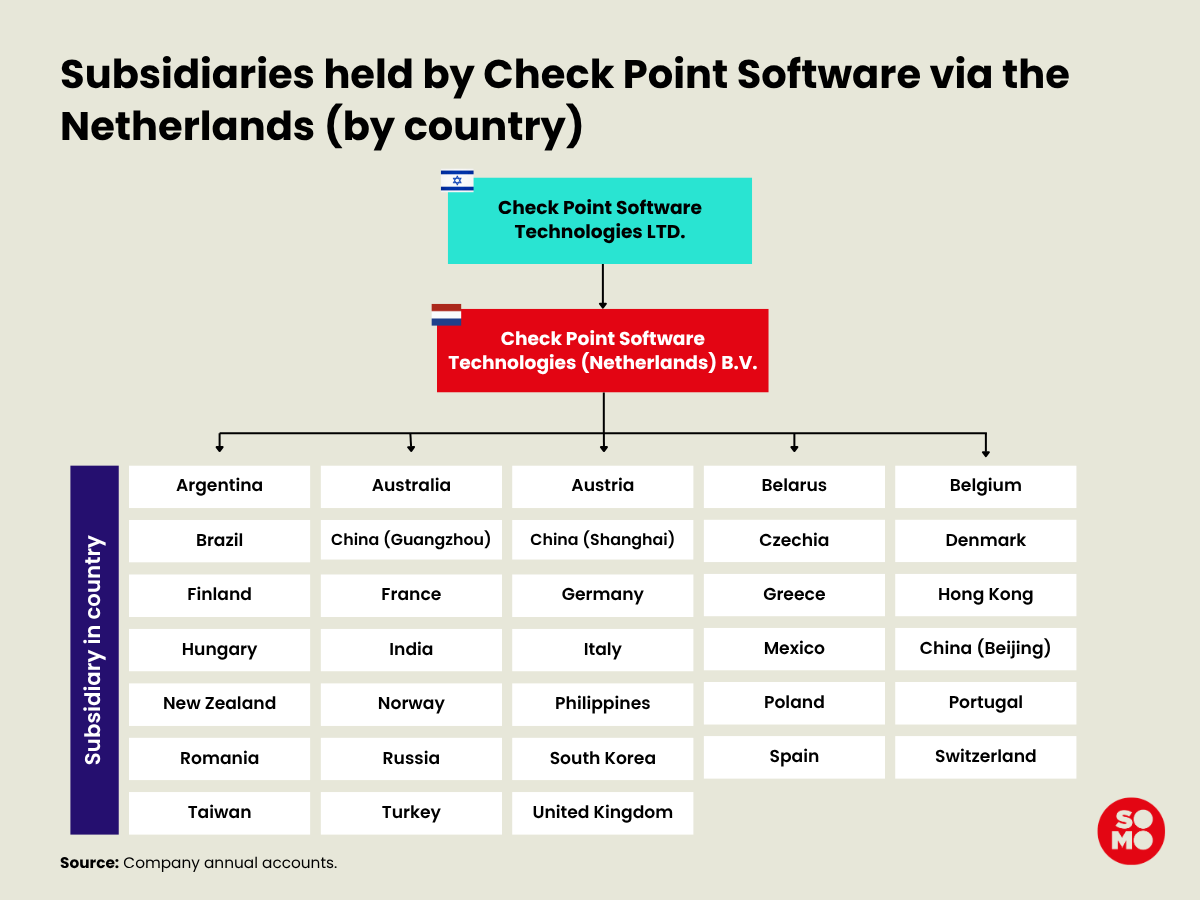
Since at least 2010, Check Point has used a Dutch company, Check Point Software Technologies (Netherlands) B.V., as the main holding company for its global subsidiaries. This company holds $74.5 million in assets and owns 33 subsidiaries in various countries, including China, Russia, Brazil, and Germany. The graph on ‘Check Point’s corporate structure’ shows all the subsidiaries owned by the Dutch company as per its 2025 annual report. Until 2018, Check Point Software Technologies (Netherlands) B.V. was a company with no employees, registered at the address of Dutch corporate service provider TMF Group, which was also listed as a director of the company in 2016.
In 2018, Check Point merged this company with Check Point Software Technologies B.V., Check Point’s actual Dutch corporate office in the Dutch town of Bunnik. Check Point changed its address from that of TMF Group to its office in Bunnik. From that year on, it also listed more than 20 employees in the Netherlands. This company is still used as Check Point’s main international holding company.
Check Point told SOMO that “Check Point’s Dutch entity is part of the company’s long-established international corporate structure that supports its global operations. Like many multinational companies, Check Point uses international entities to manage its operations, and it would be incorrect to suggest that this structure implies political affiliation or improper conduct.”
Palo Alto Networks
US cybersecurity company Palo Alto Networks, one of the world’s largest tech companies, uses a Dutch company to provide loans and cash to its Israeli subsidiary. Palo Alto Networks is listed on both the Nasdaq Stock Market and the Tel Aviv Stock Exchange.
US cybersecurity company Palo Alto Networks is one of the world’s largest tech companies, with a market capitalisation(opens in new window) of over $200 billion as of May 2026 and a 2025 revenue of $9.2 billion.(opens in new window) It was founded in 2005 by Nir Zuk(opens in new window) , who previously served as head of software development for the Israeli military’s cyber intelligence unit, Unit 8200 (described above). Zuk retired from his role as Chief Technical Officer in 2025. He is still listed on Palo Alto Networks’ website as part of the company’s Leadership Team as “Founder-Emeritus”(opens in new window) . The chairman and CEO of Palo Alto Networks since 2018 is Indian-born former Google executive Nikesh Arora.
Israel is a key country(opens in new window) for the company. Palo Alto Networks’ largest R&D centre outside of the US is in Israel, with 1,600 employees(opens in new window) in the country(opens in new window) . It has spent over $1.5 billion(opens in new window) to buy 12 Israeli startups since 2014(opens in new window) . In communication with SOMO, Palo Alto Networks confirmed that it “has acquired multiple Israeli cybersecurity companies over the years,” and stated that “these acquisitions reflect that Israel has a strong talent pool of cybersecurity experts and businesses.”
Palo Alto Networks is listed on both the Nasdaq Stock Market and the Tel Aviv Stock Exchange. It took on a dual listing on the Tel Aviv Stock Exchange after the acquisition(opens in new window) of Israeli cybersecurity company CyberArk for $25 billion in February 2026. The Israeli Innovation Authority(opens in new window) called the dual listing “a symbolic and structural turning point for Israel’s tech sector”(opens in new window) .
There is no publicly available information on Palo Alto Networks’ customers in Israel. In March 2026, the company won “Israel’s largest network security tender from a major Israeli customer”(opens in new window) in a partnership with Israeli cybersecurity firm Danet Communications Ltd, a subsidiary of Israeli tech firm Accel Solutions. The project is estimated to be worth up to NIS 500 million (ca. €145 million) and will provide cybersecurity protection for “critical network infrastructure”(opens in new window) of an undisclosed “major Israeli customer”.
The general manager of Palo Alto Israel stated(opens in new window) on winning the tender: “We see great importance in deploying Palo Alto Networks’ most advanced cybersecurity protection solutions to provide the highest-quality and most innovative protection for critical network infrastructure in Israel.”
Because the identity of the customer has not been made public, it is not possible to determine whether they are the Israeli government, a security-related actor, or a customer in the commercial or civilian domain.
The role of Dutch subsidiaries in Palo Alto Networks’ Israeli operations
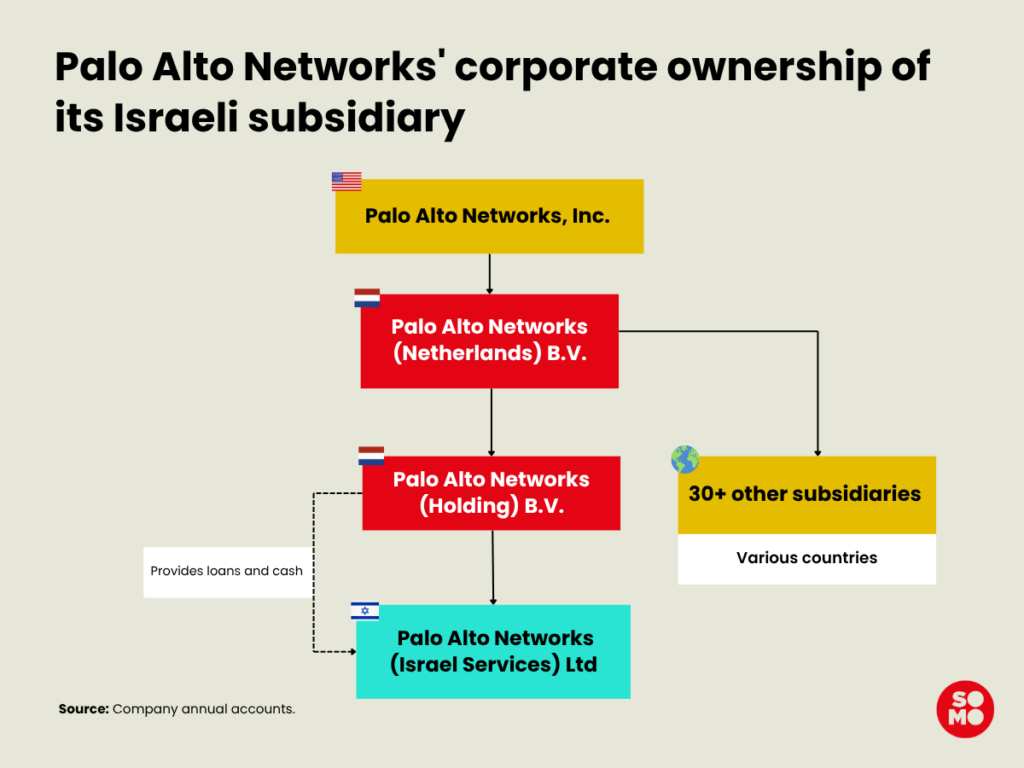
Palo Alto Networks has a Dutch subsidiary, established in 2012, for the sales and marketing of its products and services, and the distribution of security platform solutions for its non-Americas business operations. This subsidiary, Palo Alto Networks (Netherlands) B.V., has 326 employees in the Netherlands and recorded $2.65 billion in revenue in 2025. It holds over 30 of Palo Alto Networks’ subsidiaries across a number of countries, including Germany, China, and South Korea. It is also the owner of another Dutch subsidiary, Palo Alto Networks (Holding) B.V., which has no employees and holds $522 million worth of assets, according to its 2024 annual accounts.
According to Palo Alto Networks’ own annual accounts, “the main asset held by Palo Alto Networks (Holding) B.V. is a 100 per cent shareholding in Palo Alto Networks (Israel Services) Limited”, a subsidiary of Palo Alto Networks in Israel. The Dutch holding company is also used to provide cash and loans to the Israeli subsidiary.
The company’s annual accounts for 2018 through 2024 only mention loans and cash contributions to the Israeli subsidiary. In 2017, Palo Alto Networks (Holding) B.V. provided a $104 million interest-free loan to Palo Alto Networks (Israel Services) Limited. In 2019, it provided two interest-free loans to the Israeli subsidiary, one worth $158 million and the other $223 million.
In 2023, Palo Alto Networks (Netherlands) B.V. made two cash contributions to Palo Alto Networks (Holding) B.V., for respectively $254 million and $450 million, to fund the acquisition of two Israeli cybersecurity companies, Dig Security(opens in new window) and Talon Cyber Security(opens in new window) . Palo Alto Networks (Holding) B.V. subsequently contributed these cash sums entirely to the Israeli subsidiary, Palo Alto Networks (Israel Services) Limited.
Palo Alto Networks told SOMO that Palo Alto Networks (Holding) B.V. functions as a “centralized corporate treasury and holding vehicle for the group’s international investments”, which it described as a standard practice for multinational enterprises. Its full response can be found here.
Do you need more information?
-

Jasper van Teeffelen
Researcher
-
 File 1: Flag swapping capital: a Dutch investment servicePosted in category:News
 Jasper van TeeffelenPublished on:
 -
 File 2: Indefensible: Dutch support to Israeli arms manufacturersPosted in category:News
Jasper van TeeffelenPublished on:
File 2: Indefensible: Dutch support to Israeli arms manufacturersPosted in category:News
Jasper van TeeffelenPublished on: -
 File 4: Israel’s corporate giants at home in the NetherlandsPosted in category:News
Jasper van TeeffelenPublished on:
File 4: Israel’s corporate giants at home in the NetherlandsPosted in category:News
Jasper van TeeffelenPublished on: -