
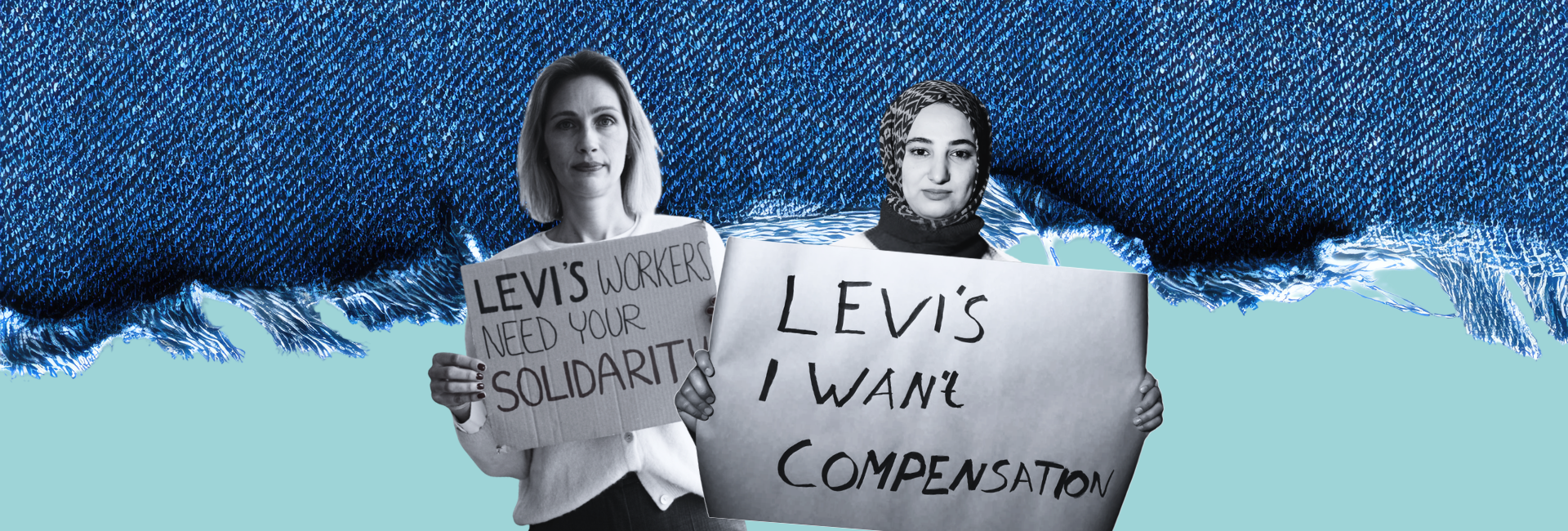
Levi’s sued over misleading claims on labour conditions
Today, 21 April 2026, the Dutch office(opens in new window) of the Clean Clothes Campaign (CCC) network, with support from SOMO, filed a groundbreaking lawsuit(opens in new window) against Levi Strauss Nederland B.V. and Levi Strauss & Co Europe BV (together “Levi’s”), Dutch and Belgian subsidiaries respectively of denim giant Levi Strauss & Co. The core argument of the lawsuit is that Levi’s has used misleading claims about the labour conditions in its supply chain when advertising its products to Dutch consumers. CCC is joined by four individual consumers who purchased Levi’s products on the basis of the misleading claims.
Both online and in Dutch stores, Levi’s made consumer-facing statements about responsible production and respect for workers’ rights, such as the right to freely join a trade union. These statements were ostensibly intended to convince consumers they were buying from an ethical brand.
The consumers became aware of the misleading nature of these claims in 2025, when CCC launched a campaign amplifying stories of severe worker repression at a Turkish factory producing exclusively for Levi’s. Workers who peacefully protested for better working conditions were met with violence by provincial security forces and later fired. The hundreds of affected workers are still demanding compensation. According to the labour watchdog Worker Rights Consortium and Levi’s own code of conduct, Levi’s should have remedied the violations of workers’ fundamental rights and freedoms at work.
“Levi’s gave me the impression that they care about social responsibility. Knowing what happened in Turkey, I feel misled and don’t feel proud of my purchase anymore,” says Patrick van Klink, one of the participating consumers. “Levi’s should stay true to its promises”, he added.
According to Funda Bakis, one of the affected workers, who was employed at the Levi’s supplier for four years, “We were laid off because we used our right to organise. At home, I live with seven siblings. At some point, we could not even meet our most basic needs. We went through very difficult times with my family. We asked Levi’s for help, but they did not hear our voice.”
Advocates for the Turkish workers, including their trade union and CCC, have repeatedly asked Levi’s to take action, but the case still has not been remedied. Bego Demir (CCC Türkiye) recalls: “I’ve seen with my own eyes that the reality for workers making Levi’s jeans is very different from how the brand presents it.”
“Dutch law protects consumers against misleading claims. In this case, there’s a clear contrast between Levi’s statements and its response to a concrete violation of their own code of conduct and international labour standards. From our perspective, Levi’s remedying the situation for the workers in Turkey is the best way to rectify their false advertising.” Emma Vogt, campaigner at CCC.
CCC is now awaiting a first hearing date in court. The NGO emphasises that they remain available if Levi’s is interested in re-engaging in constructive dialogue.
SOMO supports the proceedings and has assisted the case with factual research and legal strategy development. Although it is not acting as a legal representative or co-claimant, and will not take procedural steps, it continues to contribute in a supportive capacity.
“When companies make claims to consumers, those claims must be truthful, and if they are not, they can be legally challenged. This case shows that consumers have a role to play. By demanding accurate information, they help push companies to ensure that what they claim truly reflects the reality of people who make it.” Aintzane Márquez, Strategic Litigation Researcher at SOMO.
Levi’s removed a large number of the statements in March 2026 in response to a demand letter issued on behalf of CCC and SOMO. However, the lawsuit argues that this does not change the fact that Dutch consumers were misled in prior years, and that the remaining statements are still misleading to Dutch consumers.
The lawsuit against Levi’s forms part of a joint investigation by SOMO and CCC into misleading claims by fashion brands about labour conditions in their supply chains. The organisations, together with the Dutch consumers’ association Consumentenbond, previously shared their findings on the misleading use of social audits and certifications with the Netherlands Authority for Consumers and Markets, which indicated that it would investigate measures to prevent “social washing”.
Learn more about the case here(opens in new window) .
Do you need more information?
-

Aintzane Márquez
Strategic Litigation Researcher
Partners
Related news
-
 Audited ≠ Ethical: how fashion brands mislead consumersPosted in category:News
 Aintzane MárquezPublished on:
 -
 The hidden human costs linked to global supply chains in ChinaPosted in category:News
 Joshua RosenzweigPublished on:
 -
 Major brands sourcing from China lack public policies on responsible exitPosted in category:News
Joshua RosenzweigPublished on:
Major brands sourcing from China lack public policies on responsible exitPosted in category:News
Joshua RosenzweigPublished on: