
Internal Shell documents shatter corporate spin on the Niger Delta
For more than two decades now, I have worked with allies in the Niger Delta on the huge, devastating impact of oil pollution, much of it due to leaks from Shell’s infrastructure. It is hard to explain how horrific the situation in the Delta is. Despite a mountain of evidence, including photos and satellite images, compiled by civil society(opens in new window) groups, communities and UN agencies(opens in new window) , Shell has spun a narrative that almost casts it as the victim – a company doing its best in difficult circumstances. But then, every so often, there is a reckoning. A legal case where Shell is forced to disclose information. And when this happens, the truth comes out, exposing multiple examples of Shell’s negligent and self-serving action and inaction in the Niger Delta.
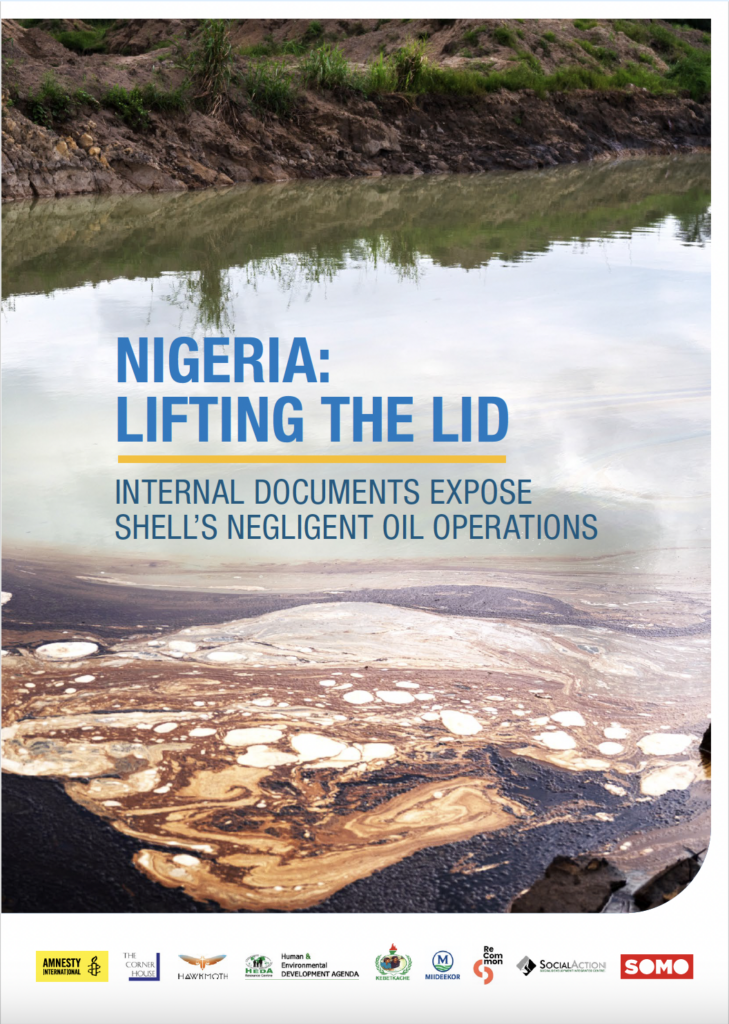
Today, a group of organisations, including SOMO, have co-published an analysis(opens in new window) of internal Shell documents disclosed in an ongoing UK legal action(opens in new window) over oil pollution. The documents expose the truth that hundreds of thousands of residents of the Niger Delta and scores of civil society groups – in Nigeria and globally – have borne witness to for years, to almost no avail. They lay bare the extent to which Shell knew about the terrible state of some of its oil infrastructure and the leaks and environmental devastation its operations were causing. The documents also show how the oil giant sought to suppress evidence of mismanagement and the parlous state of Shell’s infrastructure, and ensure that oil (and profits) continued to flow.
‘Lifting the Lid’ on Shell’s spin
This analysis exposes multiple examples of Shell’s negligent and self-serving action and inaction, including:
- How, instead of repairing tapped pipelines, as required under Shell’s internal rules, executives allowed taps to be left in place to minimise oil flow disruption – despite being told that this would result in environmental damage.
- How some of Shell’s pipelines were old and not being maintained in line with accepted standards. One document stated that, “[Shell Petroleum Development Company of Nigeria] flowlines are…supposed to be replaced with a fixed frequency (every 15 years). This process of replacement is however not being followed, and only breakdown maintenance is applied.”
- The revelation that Shell executives assumed staff and contractors were likely involved in oil theft. The company blames much oil pollution on oil theft, but has consistently failed to prevent it. The alleged involvement of Shell staff or contractors has been raised for years.
- Shell executives knew its rules were being broken by staff in Nigeria. One Shell manager emailed in 2012, after visiting Nigeria, that: “there is collusion, nepotism and corruption running through the veins of [Shell Petroleum Development Company of Nigeria]………the fact is no one bats an eyelid here. Shell’s Code of Conduct is an inconvenience here: it’s completely ignored.”
The documents also reveal that the decision to sell its onshore oil business was influenced by the desire to avoid decommissioning and clean-up costs. Shell executives assessed that the likely costs of decommissioning were huge. A 2013 letter recorded that “it could take up to several decades to decommission all existing SPDC assets, and could amount to an estimated total asset retirement obligation of USD10.9bn [for the whole SPDC Joint Venture ]…”
Responding to the report, Shell says it does not recognise itself in the picture painted by Lifting the Lid. But the picture was painted in its own words, by its own actions. It may choose, even now, not to recognise itself. But it does so at the cost of the livelihoods, health and wellbeing of hundreds of thousands of people in the densely populated oil-producing region of Nigeria.
However, the truth is Shell knows better than most what its Nigerian operations have led to. A plain reading of the disclosed papers, which include a wealth of email communication between Shell executives, makes this more than clear. Shell knows how culpable the company is in the environmental devastation of the Niger Delta, and its response has been to publicly deny, spin the story to blame others, and carry on regardless.
A repeat offender for burying the truth
The revelations in Lifting the Lid are not the first time Shell has been so wholly exposed by its own internal documents. In a 2012 legal case on oil pollution at Bodo(opens in new window) in the Niger Delta, on which I worked while at Amnesty International, Shell maintained, for years, to the media and shareholders, that the amount of oil spilt was some 4,000 barrels. All the evidence was that it was vastly more. The area was destroyed. But Shell repeatedly denied the scale of the spill, even when confronted with evidence that their figures were wrong; most media outlets repeated the denials, and shareholders largely accepted what executives told them.
In the legal action, the company’s claims were exposed as false, and massively so. Experts put the volume of oil spilt at half a million barrels(opens in new window) . Shell settled the case, paying an unprecedented GBP 55 million to the community. The same court papers also revealed that Shell had known for years that its oil pipelines in the area were in very poor condition and likely to leak, with some sections of pipeline containing “major risk and hazard(opens in new window) ”.
When Shell is forced to reveal the truth about its impact in the Niger Delta, the truth turns out to be what so many communities and activists have reported for so long. Shell can only maintain its denial of responsibility because it so seldom has to disclose the reality, and because of the passive acceptance of the corporate narrative by shareholders, home states and others.
Shell’s shareholders and home governments (UK and the Netherlands) have enabled the company’s one-sided and deeply unjust narrative, failing to probe corporate responses or engage meaningfully with the extensive civil society data that calls the company’s story into question.
The Dutch government, the UK government and the company’s shareholders are all in a position to take action that can pressure further disclosure. The documents reflected in Lifting the Lid make a clear case for requiring Shell to finally come clean to shareholders (who are, after all, the owners) and to provide remedy and reparations to the people of the Niger Delta.
Responding to Lifting the Lid, Shell stated that the authors “selectively referred to and quoted from documents in a way that creates a misleading impression [sic].” The company reiterated that the report’s authors did not reflect the challenging context in the Niger Delta.
Nigeria: Lifting the lid
A cache of internal documents recently disclosed in legal proceedings in the UK against fossil fuel company Shell Plc has lifted the lid on its negligent and polluting operations in the Niger Delta.
Most of the documents – which include email exchanges between senior executives and confidential audits – have not been previously reported on.
Do you need more information?
-

Audrey Gaughran
Executive Director
Partners
-
Hawkmoth
Related news
-
Joint letter: A just and equitable critical minerals futurePosted in category:Published on:Statement
-
 How Shell turned a leaking pipeline into profitPosted in category:News
 Audrey GaughranPublished on:
 -
Investor protection blocking climate actionPosted in category:Opinion
 Bart-Jaap VerbeekPublished on:
Bart-Jaap Verbeek
Bart-Jaap VerbeekPublished on:
Bart-Jaap Verbeek