
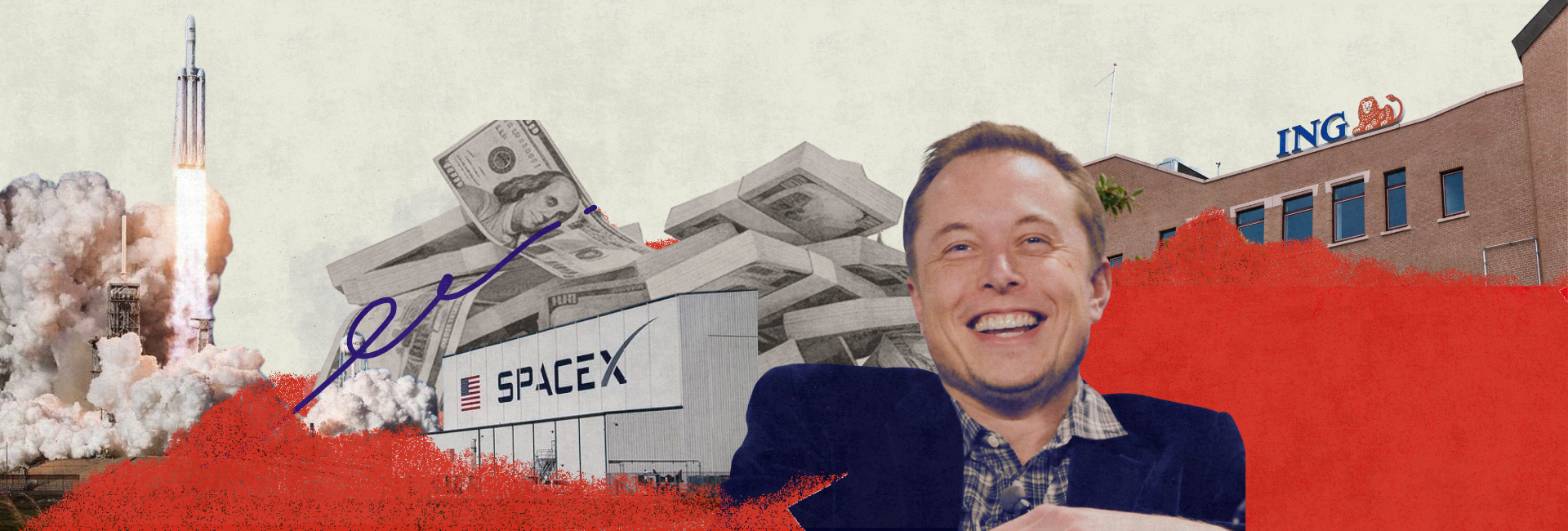
ING’s Dubious Role in Musk’s SpaceX IPO
ING is one of the banks helping Elon Musk’s SpaceX go public, in what is expected to be the largest initial public offering (IPO) in history. But for a bank that presents itself as a champion of sustainability and responsible business, involvement in the listing of a company controlled by one of the world’s most controversial billionaires raises serious questions. Read more in our op-ed, originally published in Dutch in Het Financieele Dagblad (FD).


The largest initial public offering (IPO) of all time—that of SpaceX—has an orange tinge. The Dutch bank ING is one of the more than 20 banks(opens in new window) selected to take Elon Musk’s company public this week.
Not only does ING’s name appear on the prospectus, but ING bankers are participating in the roadshows, actively steering their own retail clients toward the subscription, and are set to make a tidy profit from it. A prestigious assignment, but also one that instantly undermines the bank’s claims about the importance of corporate social responsibility.
Exceptional
The IPO of the rocket/satellite/social media/AI company is a bizarre event in many respects. For starters, the loss-making SpaceX is being valued at over nearly one hundred times its revenue(opens in new window) , which defies all financial and economic laws and logic.
You might think that if investors are crazy enough to invest in a company with a fantasy valuation, that’s their own business. But that reasoning doesn’t hold water once passive index funds come into the picture. Passive funds (such as ETFs and index funds) manage more than ten trillion euros in assets worldwide. They do not buy shares based on analysis but purely mechanically because the company is in the index.
Normally, it takes months to include a company in an index like the Nasdaq or MSCI—enough time for the market to find a fair price. Now, both indices have relaxed the rules for SpaceX, and the company will be included within two weeks(opens in new window) . This triggers a self-reinforcing mechanism: early inclusion in the index forces passive funds to buy mechanically, which drives up the price, increases the index weighting, and, in turn, leads to more mechanical buying. All of this, regardless of any underlying value.
This process creates significant artificial demand, which naturally benefits Elon Musk above all.
Political interference
Musk is a far-right populist who actively attempts to undermine democracy in the United States and Europe. On his content platform X (formerly Twitter), where he has 200 million followers, Musk regularly provides a massive platform to far-right opinion leaders and politicians.
He actively interferes in the politics of countries where he has no right to vote. For example, during last year’s German election campaign, he interviewed(opens in new window) the leader of Alternative für Deutschland and openly endorsed(opens in new window) an anti-Semitic conspiracy theory about Jewish communities.
The concerns go beyond Musk’s personal behaviour. SpaceX is a conglomerate whose individual operations each raise their own questions. Take the AI chatbot Grok, developed as an “anti-woke” AI, which, like all major AI providers, consumes energy and water on a massive scale. Musk’s solution: move data centres into space. But cooling(opens in new window) in a vacuum and protection against cosmic radiation are technical problems that no one has yet solved on this scale. Let alone the economic side.
Or take Starlink, the satellite network, presented as a democratic means of communication but which turned out to be a geopolitical tool in the Ukraine war. Musk single-handedly restricted(opens in new window) coverage over Crimea to disrupt a Ukrainian drone attack on the Russian fleet. NATO and the EU(opens in new window) are now openly asking whether they want to depend on a single man for their internet infrastructure.
Another unique aspect of SpaceX is its governance structure. Under normal circumstances, anyone who buys shares receives voting rights and protection. But at SpaceX, Musk retains over 80% of the voting rights following the IPO. He is effectively an autocrat. Musk wins every shareholders’ meeting. He appoints his own board members. And only Musk can fire Musk.
Major institutional investors share that view. Miranda Beacham, head of investments at Aegon, indicates(opens in new window) that she has serious reservations about the SpaceX IPO. The figures confirm that reservation; professional investors seem to be keeping their distance. Normally, in an IPO, about 10 per cent of the shares go to retail investors, the rest to professional parties. With SpaceX, that figure is 30 per cent.
ING is eager to fill that gap. The bank dedicates an entire page(opens in new window) on its website to explaining how its clients can easily subscribe to the IPO.
But ING also has another side, dedicating 50 of the 400 pages of its annual report(opens in new window) to sustainability. The bank wants to “play a key role in the transition to a clean and inclusive economy.” Those words now stand in stark contrast to a signature on the IPO of a company with polluting rockets, an energy-intensive AI division, and a CEO who openly espouses racist views.
Index funds will soon buy SpaceX mechanically—without judgment, without choice. ING, however, has made a choice. Actively, with its own bankers, its own webpage, and its own signature on the prospectus. That difference is exactly what matters.
ING knows what SpaceX is. ING knows who Musk is. And ING has said, “Yes, we want that”.
Note
This article is an adapted version of an op-ed originally published in Dutch in Het Financieele Dagblad (FD) on 11 June 2026.
Do you need more information?
-

Joseph Wilde-Ramsing
Advocacy Director
Related news
-
-
FMO must stop its investment in harmful industrial tree plantationsPosted in category:Published on:Statement
-
Digging deeper into ING’s climate ambition Published on:
 Rodrigo FernandezPosted in category:Publication
Rodrigo Fernandez
Rodrigo FernandezPosted in category:Publication
Rodrigo Fernandez