
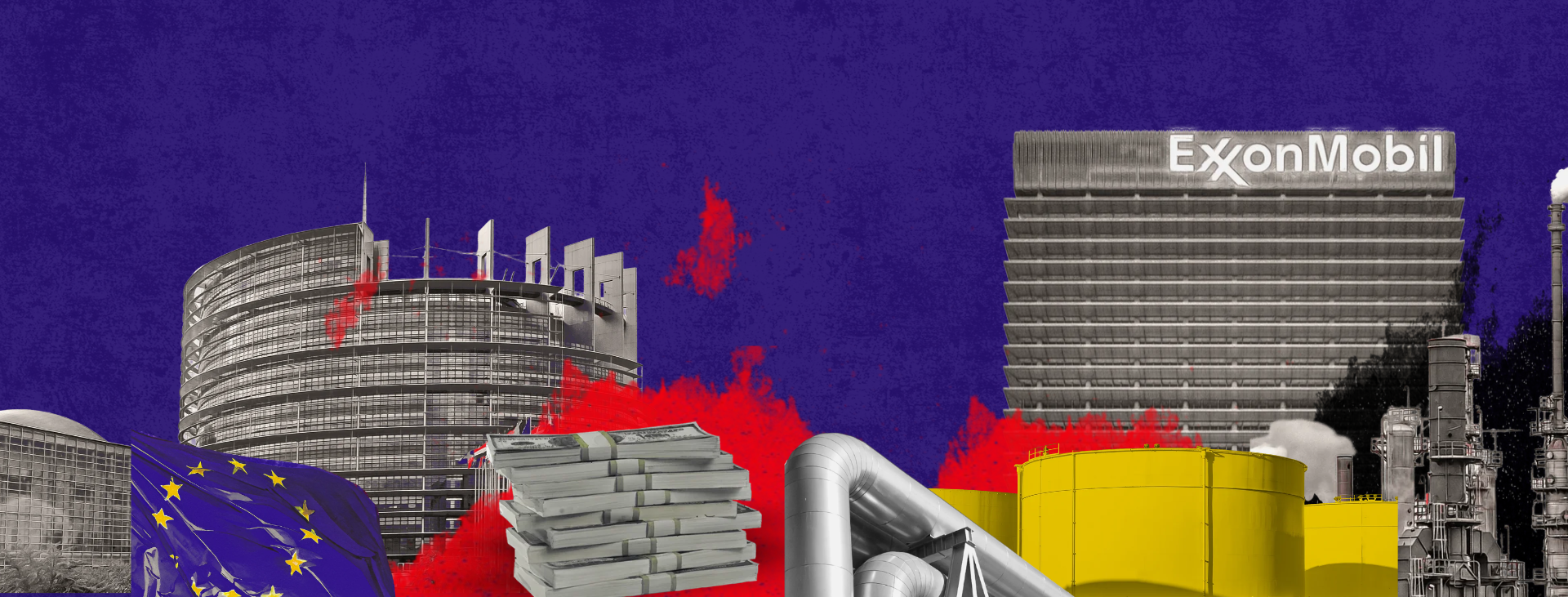
From false promises to legal pressure: ExxonMobil’s fight against EU carbon capture rules


COP31 ended without a final decision, but its proposed text reveals a growing paradox in international climate policy. While governments fail to agree on phasing out fossil fuels, corporate-led solutions like carbon capture and storage (CCS) are increasingly promoted as climate action. Against this backdrop, ExxonMobil is challenging an EU rule designed to scale up CCS, the very technology the oil major has promoted for decades as a key climate solution. The company is using investor-state dispute settlement (ISDS), a legal system that allows corporations to sue governments over policies that threaten their investments. The case exposes a fundamental contradiction. The fossil fuel industry champions voluntary CCS initiatives because they let companies keep producing and burning fossil fuels, yet resists regulatory obligations to make CCS happen. This case also shows why ISDS must be dismantled: corporate interests should no longer be allowed to obstruct climate policy.
Promoting a climate ‘solution’, unwilling to pay the bill
For decades, the world’s biggest fossil fuel companies have promoted CCS as an important tool in tackling climate change. ExxonMobil, one of the world’s largest oil and gas companies, has been particularly vocal, calling itself(opens in new window) “a global leader in carbon capture and storage”. Yet, internal ExxonMobil documents(opens in new window) obtained by Drilled and ProPublica show that already in 1988, the climate research the company supported should serve the dual purposes of protecting the value of its oil, gas, and coal while preserving the company’s business options. The company would eventually become one of the world’s major funders(opens in new window) of CCS research. In 2007, journalists reported(opens in new window) that a former ExxonMobil CEO described carbon storage as “kind of the Holy Grail” in a speech to industry leaders, while warning that the cost would be “very, very significant”. ExxonMobil has presented CCS as an opportunity to build an entirely new industry,(opens in new window) but its record of announcing ambitious capture plans without delivering equivalent investment has drawn criticism(opens in new window) .
CCS involves capturing carbon dioxide from industrial processes or other sources and transporting it for permanent storage underground. After decades of promises and billions in public money, it has delivered very little. Globally, 79% of operating capture capacity(opens in new window) in 2023-24 uses CO₂ to produce more oil, and total installed capacity is around 0.1% of global emissions. According to ProPublica’s analysis, the world is permanently (opens in new window) burying less than a single large power plant can emit in a year(opens in new window) , with only 12 large-scale geological reservoirs attempting to store CO₂ pollution, and plans for another 12 scrapped. An academic study shows how nearly 80% of large-scale projects have failed(opens in new window) over the past three decades. Nonetheless, according to data compiled by Oil Change International, the EU, its Member States, and Norway have committed nearly €17.3 billion in public money(opens in new window) to CCS and CCS-dependent hydrogen projects between 2001 and 2025.
The EU rule ExxonMobil is suing over
In 2024, under Article 23 of the Net Zero Industry Act (NZIA), the EU Commission set a clear obligation for oil and gas producers to develop the massive infrastructure needed to capture and store carbon dioxide. ExxonMobil, together with other obligated entities, pushed back. The oil giant has now taken its opposition a step further, bringing an investor-state dispute settlement (ISDS) claim against the EU under the Energy Charter Treaty (ECT).
The claim is clearly not about the costs. ExxonMobil reported adjusted earnings(opens in new window) of over $17 billion in the third quarter of 2026 alone, while Carbon Tracker(opens in new window) estimates its compliance costs at up to €78 million.
In a statement to IAReporter(opens in new window) , the company dismissed the EU measure as “based on ideology instead of logic” and “extremely costly”, arguing that it would disadvantage businesses and increase the cost of living for Europeans. It went further, declaring: “This dispute is as much about saving Europe from itself as it is about the oil and gas industry fighting yet another irrational law from Brussels.”
ExxonMobil calls it “irrational” that the companies driving the climate crisis should share the costs of the ‘solution’ they have lobbied for. That framing shows how much corporate power can dominate the political debate and decision-making. The claim also fits another pattern: ExxonMobil’s opposition to European legislation that places environmental responsibilities on large companies, including the EU’s Corporate Sustainability Due Diligence Directive and the EU Methane Regulation(opens in new window) .
CCS: a costly distraction from real climate action
CCS works as a rhetorical shield. It shifts the debate from whether to phase out fossil fuels to how to keep burning them. The COP31 draft text(opens in new window) shows how far this has gone. It does not mention phasing out oil, gas or coal, yet pledges to work towards capturing 1.3 to 2.5 billion tonnes of CO₂ a year by 2035. According to DeSmog(opens in new window) , that would mean scaling up today’s capture capacity of 68 million tonnes by a factor of 19 to 37 in less than a decade. Negotiations have increasingly framed the goal as phasing out “unabated” fossil fuels, and this wording leaves the door open to continued fossil fuel use as long as a capture technology is attached(opens in new window) . Some companies already use this loophole to justify expanding production(opens in new window) . At COP28, at least 475 CCS lobbyists(opens in new window) promoted the idea that the industry can keep producing without harming the climate. The risks of this bet fall on the communities living along the infrastructure, because capturing CO₂ means transporting it. High-pressure CO₂ pipelines can leak or rupture, potentially explosively, and release dangerous levels of CO₂(opens in new window) .
Europe is planning this at scale. The Commission’s strategy foresees a CO₂ transport network of up to 7,300 km by 2030, rising to around 19,000 km by 2040(opens in new window) . The fossil fuel industry is once again shaping the agenda. Research(opens in new window) from Corporate Europe Observatory and ReCommon shows how the Commission’s CCUS Forum is dominated by fossil fuel interests. A credible climate response starts with phasing out fossil fuels, not building infrastructure that makes continued fossil fuel burning look acceptable.
What do the EU carbon storage rules require?
Under the 2024 Net-Zero Industry Act(opens in new window) (NZIA), the EU has set a target of making at least 50 million tonnes of annual CO₂ injection capacity available by 2030 at geological storage sites within the EU. This is a target for available injection capacity – meaning to have the infrastructure and storage sites that must exist and be ready to receive 50 million tonnes a year by 2030. It is not a guarantee that 50 million tonnes will actually be captured and stored every year.
Article 23 of the NZIA requires oil and gas producers that operated in the EU during 2020–2023 to contribute in proportion to their share of EU oil and gas production during that period. In 2025, the European Commission adopted rules(opens in new window) for calculating these contributions and identified 44 obligated entities(opens in new window) .
The largest individual companies with obligations under this rule include the Dutch company Nederlandse Aardolie Maatschappij (NAM) (6.35 Mt/year), followed by the Romanian companies OMV Petrom (5.88 Mt/year) and Romgaz (4.12 Mt/year), and Polish company Orlen (4.10 Mt/year).
From lobbying to litigation: 15 cases against the EU
Initially, parts of the oil and gas industry supported the rules. The International Association of Oil and Gas Producers (IOGP), representing nearly half of the obligated entities, publicly endorsed Article 23 in an open letter(opens in new window) to the EU Commission launched in July 2023. However, once the list of obligated entities and their respective contributions to the target was published, the industry response has been both extensive and confrontational.
By the end of 2025, oil and gas producers, including ExxonMobil, had brought 15 legal proceedings before the EU General Court(opens in new window) , challenging Article 23, the methodology used to calculate obligations, or the Commission’s decision identifying the companies and their respective contributions.
The companies raise a range of arguments, including proportionality, equal treatment, legal certainty, commercial freedom, property rights and whether the 2030 deadline is feasible. Together, the litigating entities account for 65% of the overall storage-capacity obligation.
Some companies have grouped several subsidiaries into a single case, as TotalEnergies and Vermilion have done. Others have filed multiple joint cases. ExxonMobil Producing Netherlands and Mobil Erdgas, as well as BEB Erdgas und Erdöl and Oldenburgische Erdölgesellschaft, have each filed two cases together. NAM, which is jointly owned by Shell and ExxonMobil, has filed a separate case.
BEB Erdgas und Erdöl and Oldenburgische Erdölgesellschaft are also jointly owned by Shell and ExxonMobil. Their respective storage obligations, like those of NAM, are therefore divided between the two parent companies according to their ownership shares.
Although the companies have filed 15 separate cases, the claimants can be grouped into ten parent or standalone companies. The chart below consolidates the storage obligations associated with these companies, taking account of the relevant ownership shares. It therefore shows the amount attributable to each parent or standalone company, rather than necessarily the full obligations of all the individual claimants.
These are proceedings under EU law, not investment arbitration. The distinction is important. The EU courts are examining whether the measure complies with EU law. By contrast, investment arbitration, like ISDS, allows foreign investors to bring separate claims under investment treaties and seek financial compensation.
From EU courts to ISDS: ExxonMobil opens a second front
ExxonMobil is not limiting its challenge to the EU’s carbon storage requirements to EU courts. It has also turned to a different legal route: investment arbitration under the Energy Charter Treaty (ECT).
The ECT is an international investment agreement from the 1990s that protects foreign investors in the energy sector. Its ISDS mechanism allows investors to sue governments over measures they believe harm their investments before private arbitration tribunals, outside national courts. Fossil fuel companies have often used it(opens in new window) to contest energy and climate policy. The EU withdrew(opens in new window) from the ECT on 28 June 2025, because of concerns about the treaty’s compatibility with climate objectives. A growing number of individual EU Member States have also withdrawn or notified their intention to withdraw, citing similar concerns.
Yet, withdrawal does not immediately end exposure to investor claims. Under the treaty’s survival clause, investments made before withdrawal can continue to enjoy protection for another 20 years(opens in new window) .
A notice of arbitration was submitted(opens in new window) to the EU by three ExxonMobil affiliates incorporated in Belgium, Luxembourg, and the United Kingdom. Together, these affiliates appear to have brought a claim on behalf of the five ExxonMobil-linked companies in which ExxonMobil has a 50% or more ownership stake. The combined Article 23 obligation of these five companies is around 8.9 Mt of CO₂ injection capacity a year, nearly 18% of the EU’s target. Based on ExxonMobil’s ownership stake in each company, its obligation would be 5.07 Mt, just over 10%. Journalists report(opens in new window) that ExxonMobil presents the move as a response to an obligation that compels producers to provide storage capacity without a viable market for capture and transport.
There is also another concern about ExxonMobil’s legal route. By using a UK affiliate, ExxonMobil may be seeking to circumvent the EU legal order prohibiting intra-EU investment arbitration. In its Komstroy judgment(opens in new window) , the Court of Justice of the EU ruled that the ECT cannot be used to bring arbitration claims between investors from one EU member state against another EU member state. The EU and 26 Member States have since confirmed, in an Agreement on the interpretation and application of the ECT(opens in new window) , that this restriction also applies to claims against the EU itself.
At the same time, ExxonMobil is also pursuing claims through affiliates incorporated in Belgium and Luxembourg, despite these legal developments. It has previously used the same Belgian affiliate to bring an ECT case against the Netherlands over the Groningen gas field, disregarding the Komstroy objections. In both cases, ExxonMobil uses its corporate structures to bring investment treaty claims against public authorities, apparently undeterred by the EU’s efforts to prevent such proceedings.
The consequences go beyond this case. Parallel proceedings can increase legal costs, create the risk of inconsistent outcomes and put pressure on governments to settle or dilute regulation. The prospect of compensation can also contribute to regulatory(opens in new window) or administrative(opens in new window) chill, even before a tribunal reaches a decision.
ExxonMobil is also reportedly(opens in new window) seeking an interim order to suspend the application of these requirements to its affected subsidiaries while the case is being considered. If granted, the obligation could be put on hold while the dispute is ongoing. This illustrates how ISDS can be used not only to seek compensation, but also to stall the implementation of climate regulation.
The Dutch link: NAM, Groningen and Porthos
The Netherlands is where these threads meet. The largest single Article 23 obligation belongs to NAM (6.35 Mt a year, about one-eighth of the EU target), a Dutch gas producer jointly owned by Shell and ExxonMobil entities. NAM, Shell, and ExxonMobil have initiated multiple arbitration cases against the Netherlands over the closure of the Groningen gas field and liability for extraction-related damage.
ExxonMobil and Shell are also among the four users of the Porthos CCS project to supply CO₂ generated from their operations at the Port of Rotterdam to pipelines transporting the CO₂ to a platform 20km off the coast in the North Sea, where it is expected to be pumped into a depleted gas field under the sea floor. Porthos is backed by substantial public money: its four users are eligible to receive up to €2.1 billion(opens in new window) in Dutch SDE++ subsidies over the 15-year operation period, roughly half of the scheme’s(opens in new window) first-round budget.
What this says about corporate power
This case is less about one rule than about how corporate power works. The industry promoted CCS as a way to keep producing fossil fuels, received public support for it, and shaped(opens in new window) an EU rule built around flexible compliance. When that same rule became binding, companies cried foul, turning to EU courts to block it. ExxonMobil also sought to use an outdated and corporate-friendly treaty that lets it claim compensation and seek to suspend the obligation.
CCS gives the industry an argument for continued production, and ISDS protects it if that same argument becomes binding. The pattern is to promise, dilute, and then sue, while operations and payouts carry on. In the third quarter of 2026 alone, ExxonMobil distributed(opens in new window) $9.4 billion to shareholders and announced plans for $20 billion in share buybacks for 2027.
The UN climate talks are unlikely to break that pattern. These spaces have become inundated(opens in new window) with representatives of the biggest polluters. Between 2023 and 2025, European governments and the European Commission have brought over 330 fossil fuel representatives(opens in new window) to the climate talks. The outcomes of the climate negotiations contain no explicit trajectory for (or mention of) a phase-out of fossil fuels.
Rather than negotiating with fossil fuel lobbyists, what can shift the needle is pressure from outside those rooms – movements and civil society organisations pushing governments to stop the mechanisms obstructing and delaying real climate action. Governments have the means. They can stop signing investment treaties, terminate or amend existing ones, and design instruments to neutralise the ECT’s survival clause(opens in new window) . The Netherlands, which faces ExxonMobil and Shell’s own claims related to Groningen, along with the other Member States which have already decided to leave the ECT, must lead the way. Yet, governments will only act if people press them to do so. Sign the petition to stop ISDS(opens in new window) .
*SOMO reached out to ExxonMobil to offer the opportunity to respond to our assessment but received no response.
Do you need more information?
-

Bart-Jaap Verbeek
Senior Researcher -

Joanna Cabello
Head of Research
Related news
-
The carbon offset industry on trialPosted in category:Opinion
 Aintzane MárquezPublished on:
Aintzane Márquez
-
 Enough is enough: Europe can decarbonise with far less miningPosted in category:Long read
 Alejandro GonzálezPublished on:
-
 Proposed Tata Steel subsidy may rise to €11 billionPosted in category:News
 Joseph Wilde-RamsingPublished on: