Enough is enough: Europe can decarbonise with far less mining
New research shows how Europe can cut mineral demand while decarbonising road transport

Decarbonising transport is essential for the climate, and electric vehicles (EVs) play a key role. Their batteries require cobalt, lithium, manganese and nickel, and the more vehicles Europe puts on its roads, and the larger they are, the more mining it takes. Yet the scale of this demand is not inevitable. It depends on the size and number of cars that automakers choose to make and sell, the transport options available to people, and the rules and investments the European Union puts in place. New research shows that a less mining-intensive pathway is already available. Reducing unnecessary demand can ease pressure on mining-affected communities and ecosystems while making Europe less exposed to concentrated supply chains and external dependencies. So who decides the scale of Europe’s demand for these minerals?
A choice dressed up as an inevitability
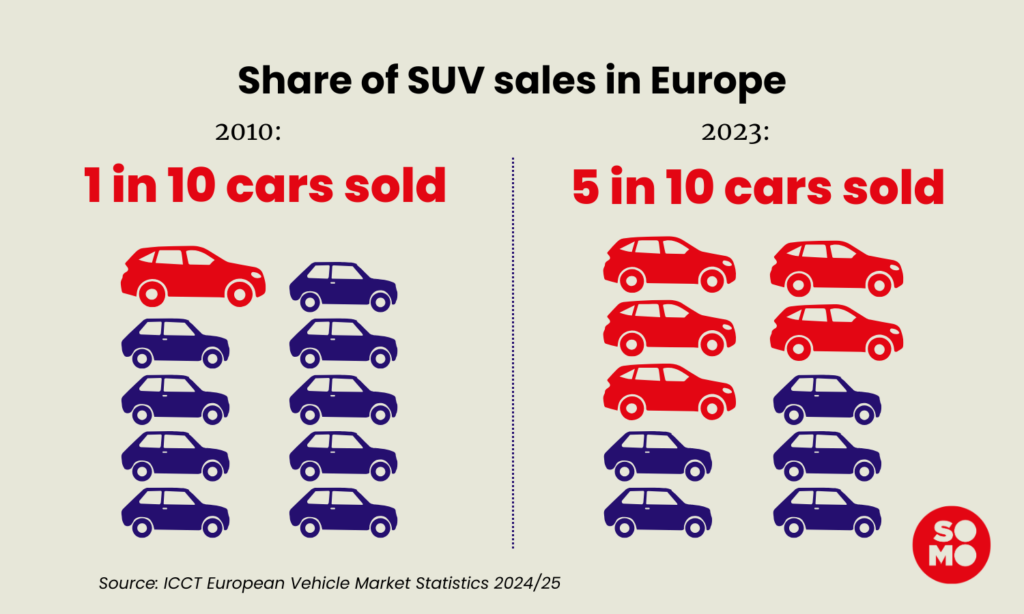
Passenger cars in Europe have grown steadily larger and heavier(opens in new window) , and the fleet keeps growing(opens in new window) . Sales of SUVs (sport utility vehicles) grew from roughly one in ten new cars in 2010 to over half of new car sales by 2023(opens in new window) . As carmakers race to electrify, the same trends continue. Larger electric vehicles need larger batteries; more vehicles need more batteries; and both mean more critical raw materials.
These trends are not accidental. They are part of a business strategy, and a small number of corporations are profiting from it. Volkswagen, Stellantis and BMW are the three largest groups in Europe’s electric car market, together accounting for over 40% of sales(opens in new window) (including plug-in hybrids) in early 2026. In fully electric cars, Tesla was Europe’s second largest(opens in new window) brand in 2025 after Volkswagen. The decisions these companies make about which vehicles to sell, and at what scale, play a major role in shaping the size of Europe’s demand for minerals.
Meanwhile, the EU’s critical raw materials strategy has concentrated largely on increasing supply of key battery raw materials through domestic extraction, diversification, strategic partnerships and stockpiling, while paying far less attention to demand. Demand has been treated as fixed, something to be met rather than shaped, quietly accepting the carmakers’ choice as a given.
If critical raw materials are scarce and strategic, the question isn’t only where Europe gets them from. It is who decides how much Europe needs in the first place.
SOMO and partners commissioned the Oeko-Institut to answer exactly that question: how much of the material demand of European passenger road transport could be avoided through different policy choices?
How to cut Europe’s mineral use?
The Oeko-Institut report(opens in new window) examines the most promising measures the EU could take today to reduce demand for key battery raw materials (cobalt, lithium, manganese and nickel) while decarbonising passenger road transport. It groups these into two kinds of measures that are complementary and operate at different levels:
- Technical measures: recycling battery raw materials, which reduces demand for newly mined raw materials, and downsizing vehicles and improving their energy efficiency, which can reduce material requirements per vehicle.
- Transformative measures: shifting journeys from private cars to public transport, cycling or walking (modal shift), and travel avoidance, which reduce the number of vehicles on the road and the distance they travel.
These levers are complementary rather than alternatives, and each can be pursued now.
Some pathways take longer to show
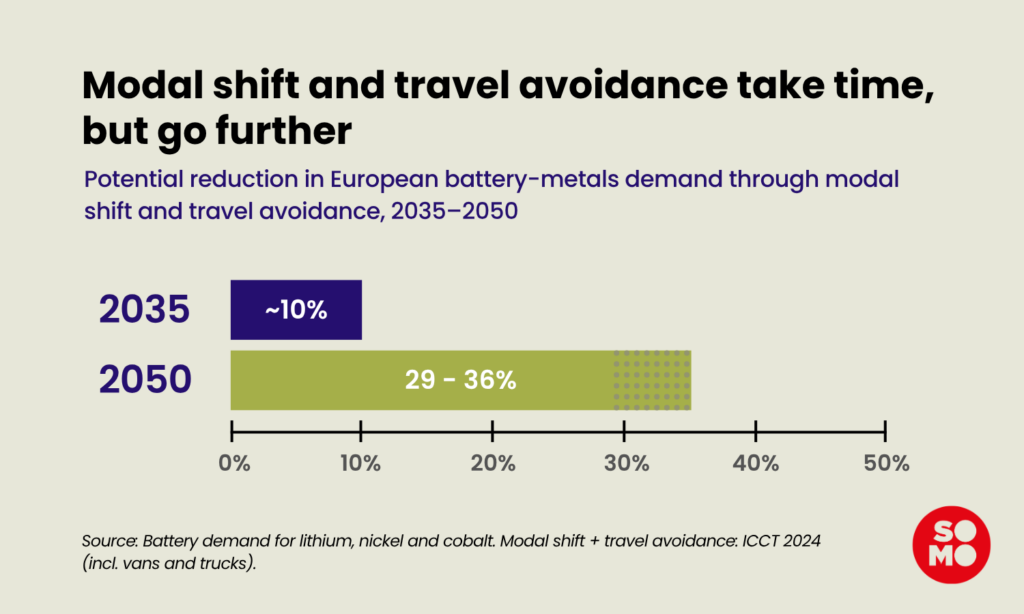
By 2035, modal shift and travel avoidance could deliver a reduction of around 10 per cent. This may seem modest, but it reflects the time these pathways need to build. They are long-term strategies built on many interventions, including better public transport and shared mobility, urban and spatial planning, and remote work arrangements, and their effects are hard to quantify. Looking further ahead, their potential grows, and they could cut mineral demand by 29 to 36 per cent(opens in new window) by 2050. Their benefits also extend well beyond materials, including cleaner air, less congestion and more liveable cities.
Electrification is key, and in the short term it makes sense to combine it with smaller, more efficient vehicles. However, Europe must also start a transformative shift away from car dependency, towards a mobility system built on affordable, accessible public transport. Yet this pathway receives the least policy attention.
Who shapes Europe’s mineral demand?
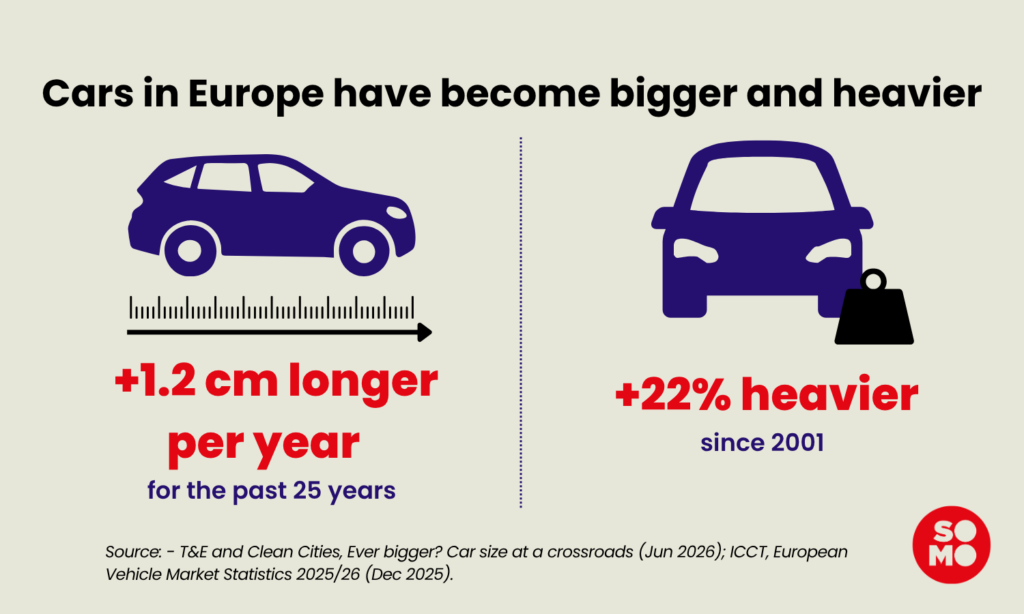
Car size is part of the answer. The average new car has grown about 1.2 centimetres longer every year(opens in new window) for the past 25 years, and its mass has risen 22 per cent since 2001(opens in new window) .
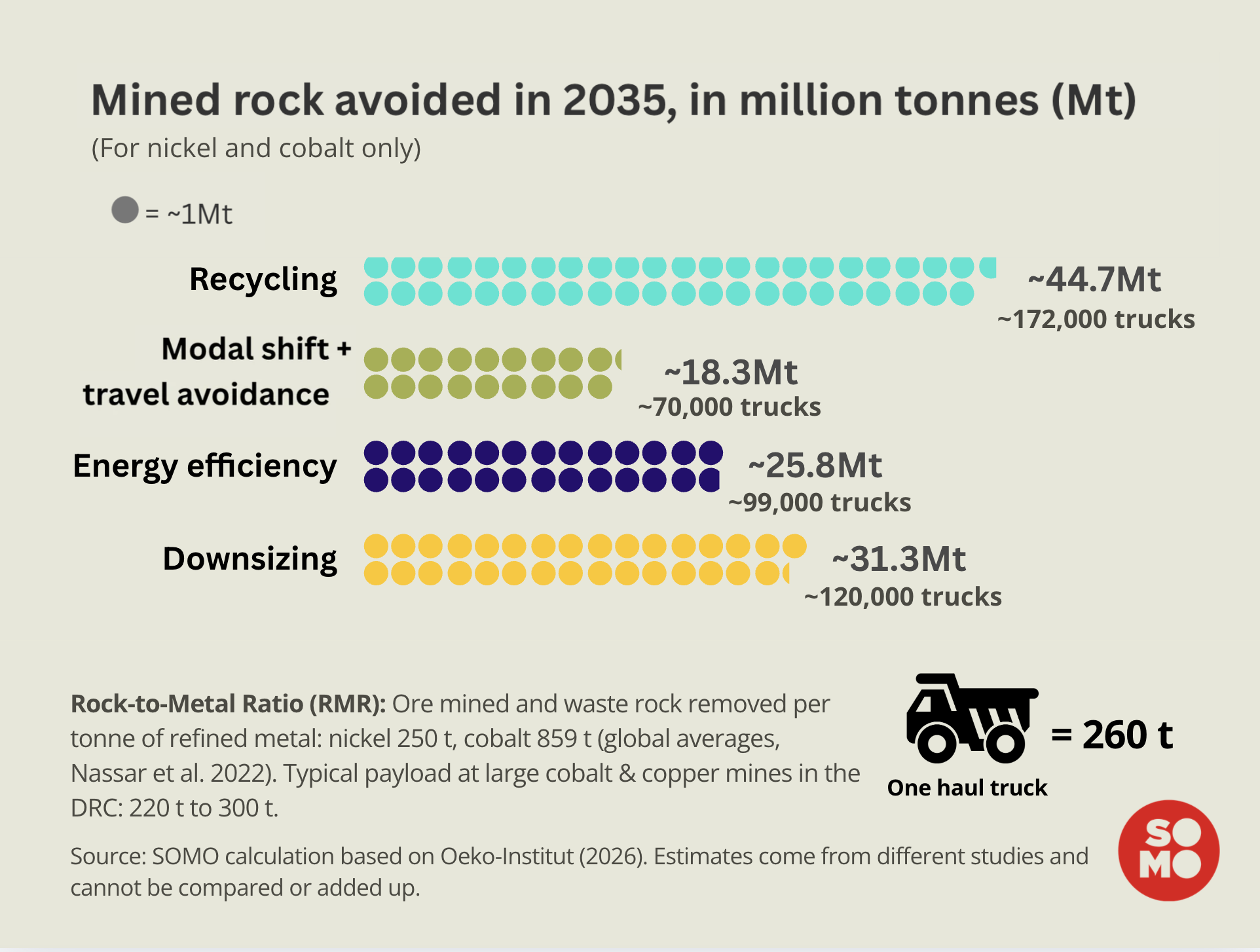
Oeko-Institut’s study found that vehicle downsizing alone could reduce European demand by around 84,000 tonnes of nickel and 12,000 tonnes of cobalt in 2035. These savings correspond to roughly 31 million tonnes of rock(opens in new window) that would otherwise need to be dug up to get the minerals. That’s equivalent to more than 100,000 fully loaded mining haul trucks in 2035 alone.
The progression towards larger cars has been a deliberate business strategy. BMW(opens in new window) has explicitly identified models in the high-end premium segment as a main driver of growth. Volkswagen(opens in new window) adopted a ‘value over volume’ strategy in 2023, prioritising higher profit margins per car over the number of cars sold, and spent nearly € 3 million(opens in new window) on EU lobbying in 2024 to defend combustion-engined cars.
BMW and Volkswagen’s strategies reflect a broader industry pattern. As SOMO documented in “Manufactured crisis”, EU carmakers’ average profit margins rose from 3.7 per cent in 2006 to 10 per cent in 2023, and over that period they captured nearly half of global gross carmakers’ profits. These corporate giants are a major factor behind Europe’s rising mineral demand.
EU regulation has failed to counter this trend. In some respects, it has enabled it, continuing a long regulatory history of favouring heavier cars. Manufacturer-specific CO₂ targets are still adjusted according to average vehicle mass(opens in new window) , an approach explicitly supported(opens in new window) by the European Automobile Manufacturers’ Association (ACEA), the main car industry lobby association. This means manufacturers whose fleets are heavier on average are allowed higher emissions targets than those selling lighter cars
This is the core of the problem: a handful of corporations that dominate the EU’s car market have built their profitability on selling larger, more resource-intensive vehicles at higher margins. Reducing Europe’s mineral demand means confronting this business model with policy intervention and public mobilisation.
Who bears the cost?
Mineral demand may be calculated in tonnes, but its impacts are experienced in territories. In Argentina’s Salar del Hombre Muerto, water diverted for the Fénix lithium operation has dried a 5-kilometre stretch of the Trapiche River wetland(opens in new window) and destroyed its vegetation. In Sulawesi and North Maluku, Indonesia, nickel mining and processing have been reported as polluting(opens in new window) drinking-water sources used by Indigenous communities. In the Democratic Republic of the Congo’s Lualaba province, independent scientific studies(opens in new window) have documented industrial-scale water and sediment pollution around major copper-cobalt mines. Behind each of these impacts are communities whose health and livelihoods are negatively affected.
These communities are not responsible for the climate crisis, nor did they choose a European transition built around more and larger cars. Yet they bear its material consequences. A transition that does not also reduce demand risks simply shifting the burden of extraction onto them.
Reducing unnecessary mineral demand does not replace the need for strong environmental safeguards, free, prior and informed consent, and accountability in mining regions. But it reduces the scale of extraction those protections must apply to. It is also a matter of fairness in access: the minerals that Europe does not demand for oversized vehicles remain available for the energy transition of Global South countries. Avoiding unnecessary extraction should therefore be a central objective of any transition that claims to be just. Real solidarity with impacted communities, particularly in the Global South, means Europe choosing to need less.
Using less also makes Europe more resilient
European mineral dependency is also a function of demand. The less material Europe needs to decarbonise transport, the less its climate transition depends on concentrated, external supply chains.
A transition dependent on materials from a handful of countries risks supply disruptions that could slow decarbonisation. In 2024, more than 85 per cent of batteries imported into the EU came from China(opens in new window) . In the same year, EU manufacturing capacity was equivalent to only 21.4 per cent of the batteries the bloc is projected to need by 2030. And even most of that capacity is not under European control: four of the EU’s five largest battery cell producers were headquartered in China and South Korea. The fewer and smaller batteries Europe needs, the less exposed it is to these dependencies.
Diversification asks where Europe’s materials should come from. Reducing demand asks how much it needs in the first place. A resilient strategy needs both.
Demand can be significantly influenced by policy choices
Oeko-Institut’s study concludes that “a less mining-intensive pathway is already technically feasible, credible and available now”. What stands between Europe and this pathway is largely political will and entrenched corporate interests, not a lack of options. Drawing on the report(opens in new window) , these are policy choices currently available to EU, national and subnational policymakers:
Direct funding towards public transport, with conditions attached
Since 2024, EU law has required every designated urban node to adopt a Sustainable Urban Mobility Plan by the end of 2027, but a 2026 European Court of Auditors(opens in new window) review found “limited ambition to get commuters out of their cars”. The EU’s upcoming Multiannual Financial Framework for 2028-2034(opens in new window) and the Social Climate Fund(opens in new window) are two clear opportunities to prioritise public funding for sustainable mobility and public transport, rather than compensatory payments that merely offset the cost of car dependency without changing it.
Use subsidies and regulation to favour smaller cars
The European Commission’s Automotive Package(opens in new window) proposes a new small-vehicle category (M1E(opens in new window) ), currently covering cars up to 4.2 metres long. The EU could lower the threshold to 4.0 metres. The EU could also encourage member states to reinforce this with vehicle-size-based taxation, parking charges and purchase subsidies to favour smaller cars. EU CO₂ targets should be reformed so that manufacturers selling heavier fleets no longer benefit from looser targets.
Regulate energy consumption, not only tailpipe emissions
Energy-efficiency measures could reduce lithium, nickel, cobalt and manganese demand by 14 per cent by 2035, savings that current CO₂ regulation does not capture. Making energy consumption a central criterion in the CO₂ emissions performance standards and the EU’s vehicle labelling system would close this gap.
Use public procurement as a lever
Public procurement criteria should require lower energy consumption and minimum shares of recycled content. Public authorities across Europe, from police forces to postal services and municipal fleets, buy enormous numbers of vehicles each year, and could use their purchasing power to demand cars that use less energy and are built with more recycled material, rather than defaulting to whatever manufacturers currently offer.
Protect and extend recycling targets
The Batteries Regulation’s recycled-content targets will be reassessed in 2028 and should be upheld. The review due by 2031 should extend them to manganese and graphite. Under the Critical Raw Materials Act, member states must also deliver their overdue national programmes to increase collection, recycling and the use of secondary critical raw materials.
Mineral demand is not destiny
Decarbonising transport is essential for the climate, and electric vehicles play an important role. But the projected scale of mineral demand is neither inevitable nor necessary. It is the product of a business model built around selling ever larger, more resource-intensive vehicles, and of a policy framework that has so far accommodated it.
Reducing this demand is possible now. It eases pressure on mining-affected communities and ecosystems while making Europe more resilient by reducing its exposure to concentrated supply chains and external dependencies. Building fewer, smaller cars and investing in affordable public transport are central to a just transition.
The industries that currently shape Europe’s mobility system have no commercial reason to choose this better path on their own. Changing course will take deliberate policy choices, and the collective action needed to win them.
Every tonne of metal Europe does not need means less pressure to open new mines, fewer communities and Indigenous peoples forced to fight for their land, and less water diverted or polluted at the expense of the people and ecosystems that depend on it.
Read the full report
-
 Decarbonising road transport beyond mining-intensive pathways (pdf, 1.76 MB)
Annex
Do you need more information?
-

Alejandro González
Senior Climate Justice Researcher
Partners
Related news
-
 Proposed Tata Steel subsidy may rise to €11 billionPosted in category:News
 Joseph Wilde-RamsingPublished on:
-
Different energy resources; same race to the bottomPosted in category:Opinion
 Sara FleischerPublished on:
Sara Fleischer
-
Internal Shell documents shatter corporate spin on the Niger DeltaPosted in category:Opinion
 Audrey GaughranPublished on:
Audrey Gaughran