
Different energy resources; same race to the bottom
The battery boom has an overproduction problem


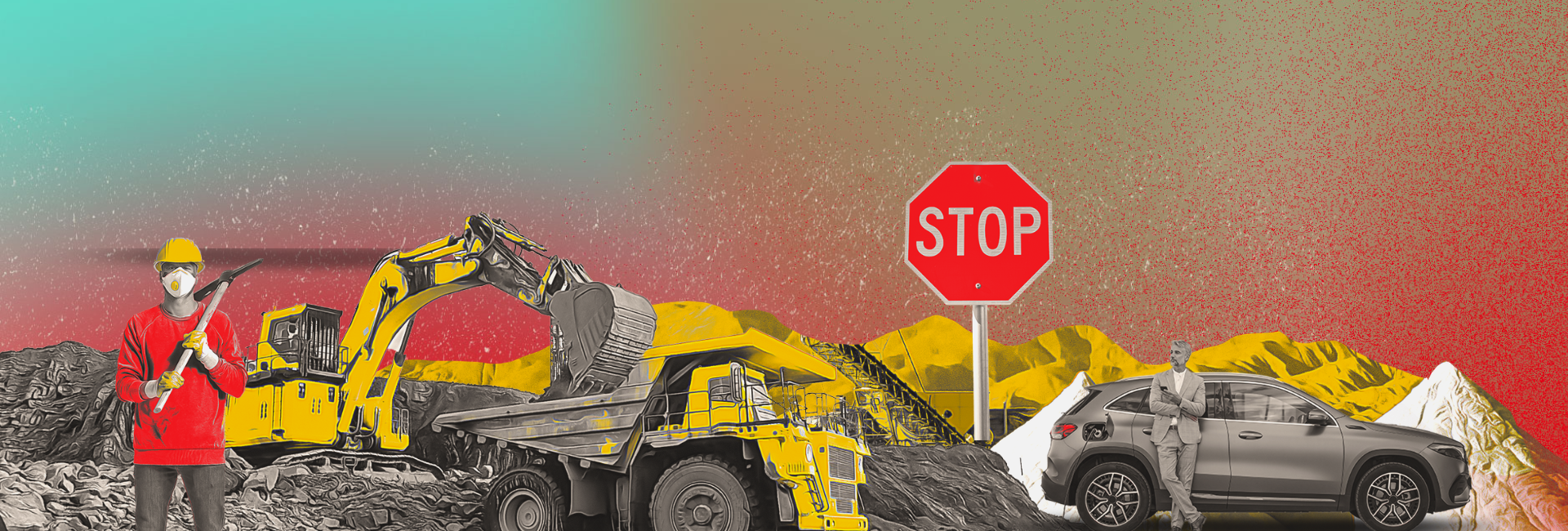
The energy transition is supposed to help us leave behind the destructive logic of the fossil fuel economy. But what if, in our rush to build a greener future, we’re simply repeating the same mistakes with different resources? That is exactly what is happening in the global battery industry. Electric vehicles are widely promoted as a cornerstone of the energy transition, yet the world is already producing far more batteries than it needs. This overproduction drives unnecessary mining, adding to the environmental destruction and human rights abuses associated with mineral extraction, while many of the batteries produced may never be used. So why are we overproducing batteries?
A just and equitable energy transition requires a responsible phase-out of fossil fuels. Discussions about how to achieve this transition often focus on electrifying transport, with large-scale production of batteries for electric vehicles (EVs) presented as key solutions.
The fact that the electrification of transport, at least under current production modes, comes with high environmental and human rights costs is widely known(opens in new window) . The devastating impacts of mining on people and the environment in mineral-rich regions are manifold(opens in new window) and well-documented.(opens in new window) What is less widely recognised, however, is that a significant share of the minerals being extracted for battery production may ultimately prove unnecessary – global manufacturing capacity for lithium-ion batteries is now estimated to be between two and five times greater than current demand.
But why is there such overproduction of batteries? What are its drivers, and how could those be addressed? These are some of the questions we explored during an online learning circle in June, organised by gaia(opens in new window) and SOMO. Participants from industry, civil society and academia shared their wide range of expertise on the topic, contributing insights, experience and knowledge to the question.
Here are our key reflections on the conversations
Overproduction is built into the system
What emerged most clearly from the discussion was that battery overproduction is not an accident or a temporary market imbalance. It is the predictable outcome of how today’s battery industry is organised. Companies compete on scale, speed and market share. Producing large amounts of batteries lowers unit costs, secures contracts with carmakers, and helps crowd out competitors. In such a system, producing more batteries than the market currently needs can become a rational business strategy rather than a mistake. After a while, it allows a few large corporations to dominate the market, creating an oligopolistic industry.
A number of factors exacerbate this dynamic. Among them are industrial policies aimed at enhancing domestic battery manufacturing capacity—such as the Net Zero Industry Act in the EU and the Inflation Reduction Act in the US—which have encouraged rapid expansion of production. At the same time, many car-makers decisively misjudged demand for their batteries, as such demand turned out to be much lower than anticipated. Those inaccurate predictions, combined with state-supported capacity expansion, have led to an increasing gap between supply and demand, with overproduction as the result.
Paradoxically, those dynamics also undermine a more circular economy. A circular economy (opens in new window) is one that keeps materials in the system instead of turning them into waste, through processes like maintenance, reuse, refurbishment, remanufacture, recycling, and composting. However, the dynamics at play in the battery industry incentivise the opposite – a linear economy(opens in new window) . A linear economy is characterised by resource extraction for products that become waste after use and are thrown away – the take-make-waste-economy. This economic model is intrinsically at odds with the finite amount of resources our planet provides, dooming it to fail, as resources that are not recycled will be used up eventually. In the battery industry, new batteries become very cheap due to overproduction, which makes repairing, repurposing or recycling existing ones less economically attractive. As this means that selling more products is rewarded more than using fewer materials, companies optimise for large-scale production rather than for products to be durable, entrenching a linear economic model.
Who pays the price?
Maintaining a linear economy means that the profits of battery overproduction are reaped by a few market-dominating corporations, while many of the costs are borne by communities, workers and ecosystems in mineral-rich areas. Once again, the logic of profit maximisation leads to a race to the bottom: the environment is destroyed, people’s rights are violated, and a linear economy with all its negative consequences for the future of our planet with finite resources is kept intact.
What is the alternative?
If we actually want to pursue an energy transition that is greener and more just, then we must recognise that the current scale of battery production is incompatible with that goal. Simply replacing fossil-fuel vehicles with electric ones while maintaining ever-growing production and consumption will not deliver a just transition; our demand for materials and resources needs to reduce too. This means prioritising public transport, shared mobility, smaller and more efficient batteries, and circular business models that value durability and reuse over endless expansion.
However, while demand reduction remains essential, it is not enough. If battery production continues to be driven by competition for market share, encouraged by public subsidies with few social or environmental conditions, and driven by business models that reward producing ever more, unnecessary extraction will continue. When it comes to the battery industry, achieving a just transition requires changing those incentives, redirecting policies and subsidies towards a circular economy and preventing oligopolistic markets where competition is defeated by continuous overproduction. Otherwise, we risk replacing one extractive model with another—different energy resources, same race to the bottom.
Read the full discussion paper here(opens in new window) .
Do you need more information?
-

Sara Fleischer
Policy & Advocacy Officer -

Alejandro González
Senior Climate Justice Researcher
Related news
-
Internal Shell documents shatter corporate spin on the Niger DeltaPosted in category:Opinion
 Audrey GaughranPublished on:
Audrey Gaughran
Audrey GaughranPublished on:
Audrey Gaughran -
Joint letter: A just and equitable critical minerals futurePosted in category:Published on:Statement
-
 How Shell turned a leaking pipeline into profitPosted in category:News
Audrey GaughranPublished on:
How Shell turned a leaking pipeline into profitPosted in category:News
Audrey GaughranPublished on: