

Behind the barrel: The oil traders fueling Israel’s genocide
How did two little-known private companies become important traders of crude oil for Israel? This long-read reveals how two oil traders help supply the crude oil that fuels Israel’s ongoing military aggression against Palestine, despite mounting legal findings of violations of international law, including genocide. Drawing on shipping data, this research by Oil Change International (OCI) and SOMO, supported by Data Desk, shows how the two companies – Vitol and Heritage Petroleum FZCO – have emerged as major players in crude oil shipments to Israel since late 2023. These two companies have collectively delivered 22 million barrels, representing 11 per cent of the country’s total crude imports. This oil is refined into fuels that, among other things, support Israel’s unlawful military and settlement activities. International bodies have affirmed states’ obligations to prevent genocide and avoid contributing to illegal occupation, settlements, and apartheid, including by regulating companies under their jurisdiction that trade or facilitate the shipment of crude oil to Israeli refineries. But are states fulfilling their legal obligations?
Key findings
- Two little-known private trading companies have become important traders of crude oil to Israel, through shipments departing from Türkiye and Russia, using Greek-owned and managed vessels.
- Vitol, one of the world’s largest private commodities traders, dramatically increased its crude oil shipments to Israel’s in 2025, delivering four times more than its 2020-2024 average annual volume.
- Between January 2025 and June 2026, Vitol was the largest named charterer supplying oil to Israel by volume.
- Heritage Petroleum, a newly established Dubai-based trader, chartered its first crude oil shipments to Israel in November 2024, and became Israel’s second-largest charterer of crude oil shipments to Israel over the past year (July 2025–June 2026).
- Israel imports 97% of its crude oil supply, which is refined into fuel that, among other things, is supplied to the Israeli military. States are obliged to prevent trade that can contribute to the commission of genocide, apartheid or that assists in the maintenance of the illegal occupation and settlements.
- States like Türkiye, Greece, Switzerland and the UAE are failing to take effective regulatory measures to ensure that corporations domiciled in their jurisdiction cannot trade or facilitate the shipment of crude oil to Israeli refineries.
Around the world, people pay the price of Israel and the United States’ illegal military aggressions and humanitarian law violations. In Southwest Asia, their military forces have attacked and displaced millions of people in Palestine, Lebanon, and Iran. Israeli forces killed more than 26,700 people(opens in new window) in Gaza in 2025 alone, and in the first months of 2026, Israeli and U.S. attacks in Iran and Israeli attacks in Lebanon led to more than 7,000 deaths(opens in new window) . Their military aggression has caused wider global impacts, including a “triple shock of energy affordability and availability, food price increases, and GDP downturns” that risks sending 30 million people worldwide into poverty, according to the United Nations(opens in new window) .
Israel relies heavily on imported crude oil. In 2024, for example, the country imported 97 per cent of its crude oil(opens in new window) , which Israeli refineries then processed into different products, including fuel supplied to Israel’s military. While it is not possible to ascertain the exact level of dependency the Israeli military has on fuel refined in the country from imported crude, the available evidence shows that part of the military’s fuel needs are met this way.
OCI, SOMO, and many others have previously argued for an embargo on the export of crude oil to Israel, given the high likelihood that it sustains or expands unlawful military action. We have focused on the countries that have supplied oil to Israel and some of the most prominent oil companies involved. This briefing looks at a different set of actors, some of the key facilitators: oil commodity traders. These companies, often operating in the shadows, facilitate the purchase of crude oil from oil producers and its sale to end users, both states and private actors. We look at two little-known companies that play a major role in shipping oil to Israel, and highlight the role of states situated along Israel’s oil supply chain and their obligation to take action.
Crude oil industry roles
- What is a “producer”? A producer is a company that extracts crude oil.
- What is a “trader”? A trader is a middleman who buys crude oil from a producer and sells it to refineries or end users. Traders move crude oil to capitalise on price gaps caused by geopolitical events, shifts in supply and demand, logistical bottlenecks, and other changes – aiming to “buy low and sell high.” They can act as charterers. In contrast, a financial trader bets on price changes without any ownership of physical oil.
- What is a “charterer”? A charterer is a company that hires a ship for a specific voyage or time period. The charterer organises cargo transport to move crude oil between locations. The charterer may or may not own the cargo.
- What is an “integrated oil company”? An integrated oil company handles everything from production to transportation to refining crude oil into gasoline, diesel, and jet fuel and selling it to end users. Integrated oil companies combine the producer, trader, charterer, and/or refiner roles.
- A typical scenario: A trader buys oil from a producer seeking to maximise profits by taking advantage of shifting market dynamics. The trader (now acting as the charterer) charters a vessel to pick up the oil and transport it to the end user.
How crude oil arrives in Israel
The vast majority of crude oil imported by Israel originates from Azerbaijan and Kazakhstan. Several publicly listed oil companies, including Chevron(opens in new window) , BP(opens in new window) , ExxonMobil(opens in new window) , Shell(opens in new window) , TotalEnergies(opens in new window) , and Eni(opens in new window) have faced criticism over their role in supplying crude oil to Israel, and in the case of U.S. company Valero(opens in new window) , supplying military jet fuel.
The role of oil traders has received far less attention, although they are critical to the process of exporting and importing oil. Most are opaque companies with far less name recognition than Big Oil corporations. This research looks at two traders – Vitol and Heritage Petroleum FZCO (Heritage) – that have delivered crude oil to Israel during the genocide. Vitol has significantly increased its crude oil shipments to Israel since 2023, while Heritage, a company created in 2023, only began shipping crude oil to the country in November 2024 after the genocide began.
Methodology
OCI and SOMO commissioned Data Desk to provide an overview of the shipments of crude oil to Israel since 2023. The findings are based on the known “charterers” recorded in the Kpler database, which includes trade data and maritime transfer tracking. This report uses the term “trader” to refer to Vitol and Heritage, where, in addition to acting as charterers, Kpler data indicates they have also bought the crude oil they are shipping. As traders, they adopt the cargo on a free on board (FOB) basis, meaning they absorb the risks and costs of shipping the cargo to the destination. SOMO and OCI reviewed the available data on shipments of crude oil that departed the originating country between 13 October 2023 and 30 June 2026 and were subsequently delivered. We tracked more than 250 shipments containing crude oil from 19 countries, amounting to more than 200 million barrels. Analysing the shipping data, two oil traders jumped out: Vitol and Heritage Petroleum FZCO. These companies respectively increased and started their crude oil supply after the start of Israel’s genocide in Gaza, and quickly became some of the largest charterers of crude to Israel. In addition to Kpler data, the briefing also draws on supplementary data from London Stock Exchange Group (LSEG), inspection data from Port State Control, and satellite images. SOMO and OCI shared key findings with all the companies named in this publication, providing them with an opportunity to comment. Responses were received from Vitol, Shiptech, and Thenamaris and are reflected in this publication.
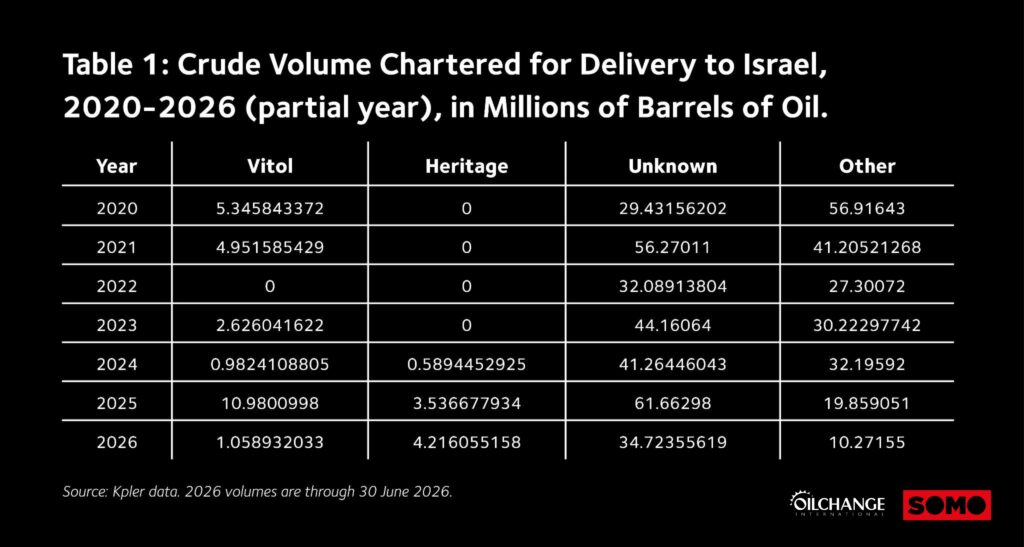
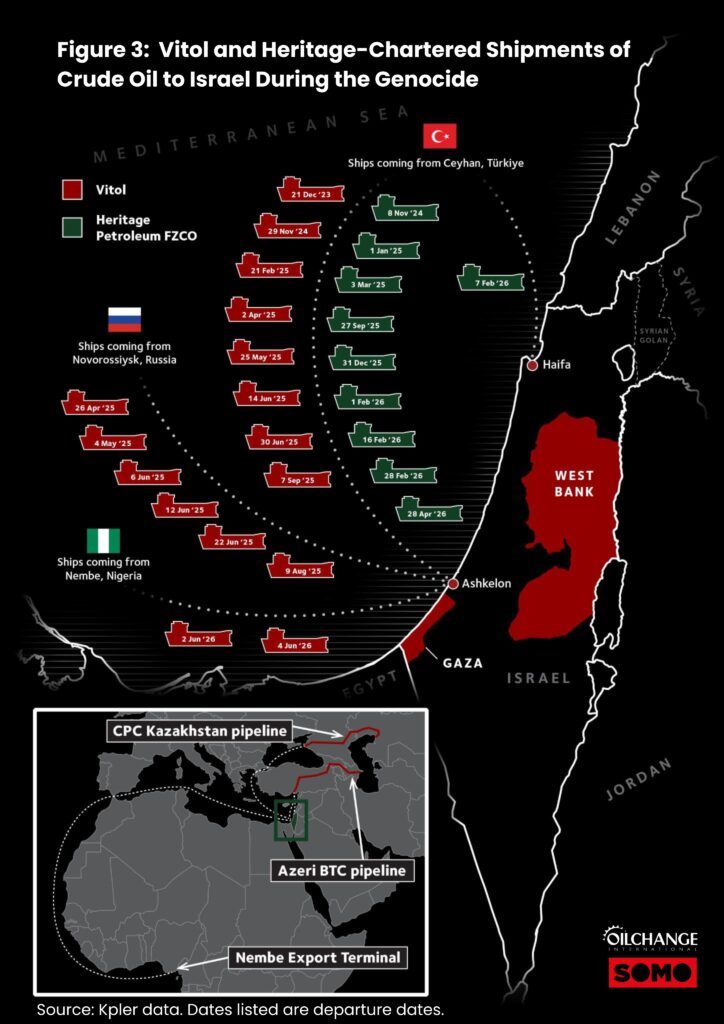
Vitol and Heritage have emerged as key suppliers of crude oil to Israel since late 2023, together delivering 22 million barrels, representing 11 per cent of the country’s crude oil imports during Israel’s genocide in Gaza. Their role may be even larger; around half of the shipments analysed for this research do not list a charter company. Companies are not required to disclose their charterers and Kpler data (see Methodology) includes many shipments of crude to Israel where the name of the company chartering the vessel is not listed.
Vitol has shipped oil to Israel for years, but in 2025 it increased its deliveries dramatically to more than four times its average annual volume recorded for 2020 to 2024. Between January 2025 and June 2026, Vitol was the largest named charterer supplying oil to Israel by volume. Heritage only began shipping oil to Israel in November 2024, but rapidly increased its shipments over the following year (July 2025 to June 2026) to become the second-largest named charterer by volume according to Kpler data.
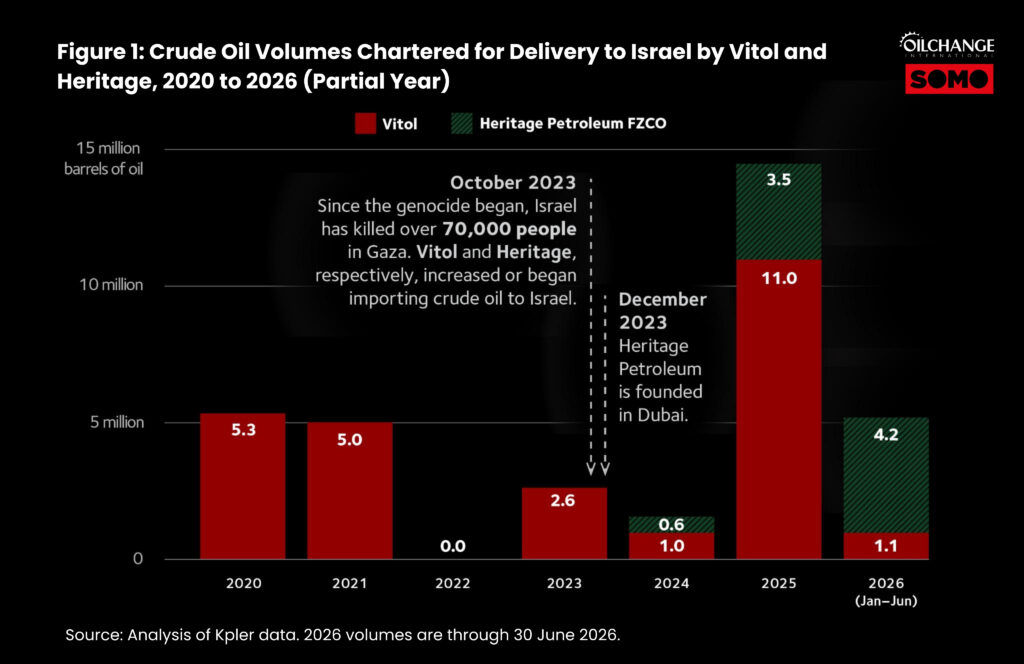
In the period between October 2023 and June 2026, Vitol and Heritage delivered 22 million barrels of crude to Israel’s state-owned Europe Asia Pipeline Company (EAPC), and Heritage delivered an additional 500,000 barrels to the Bazan refinery in Haifa.
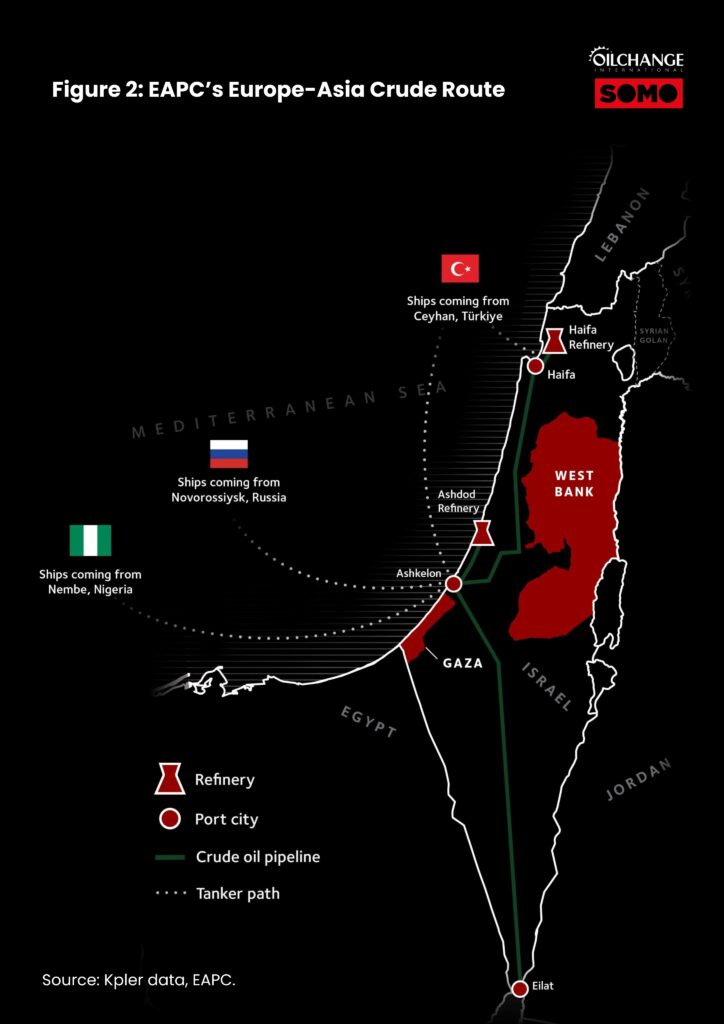
From crude imports to fuel for Israel’s military
The EAPC works under a government-issued secrecy order that covers, among other things, the identities of its shareholders and details of its oil deals. The company operates three crude oil pipelines, connecting its Ashkelon port with refineries in Haifa and Ashdod. Once refined, products are transported to be consumed or stored, including by the military. Approximately 75 per cent of the crude oil imported into Israel and refined in Ashdod and Haifa comes in via EAPC’s Ashkelon port or an EAPC port in Eilat.
Bazan Group, which owns the Haifa refinery, has been clear that it supplies the Israeli military. In December 2023, Bazan posted a video proclaiming “Together, We Shall Win!” and “Even during emergency periods, our gate is open to everyone, providing a supply of fuel for transportation to the energy sector and the military”.
One of the products the Ashdod refinery produces is jet fuel. Its largest customer, Paz Group, which buys and sells the jet fuel as an important part of its revenue, has an agreement with the Israeli Ministry of Defence for the refuelling of Israeli military aircraft in seven Air Force bases.
Vitol – the biggest company you’ve never heard of
Sometimes called the “biggest company you’ve never heard of”(opens in new window) , Vitol is a leading oil trading company, founded in Rotterdam, the Netherlands, in 1966 with regional offices in London, Geneva, Houston, Singapore, Rotterdam, and Bahrain, and a major holding company in Luxembourg. It is among the largest private commodities traders in the world(opens in new window) , with crude oil and petroleum products at the core of its business. In 2025, the company delivered an average of 8 million barrels of oil per day, and it made an average annual net profit of more than USD 12 billion(opens in new window) from 2022 to 2024.
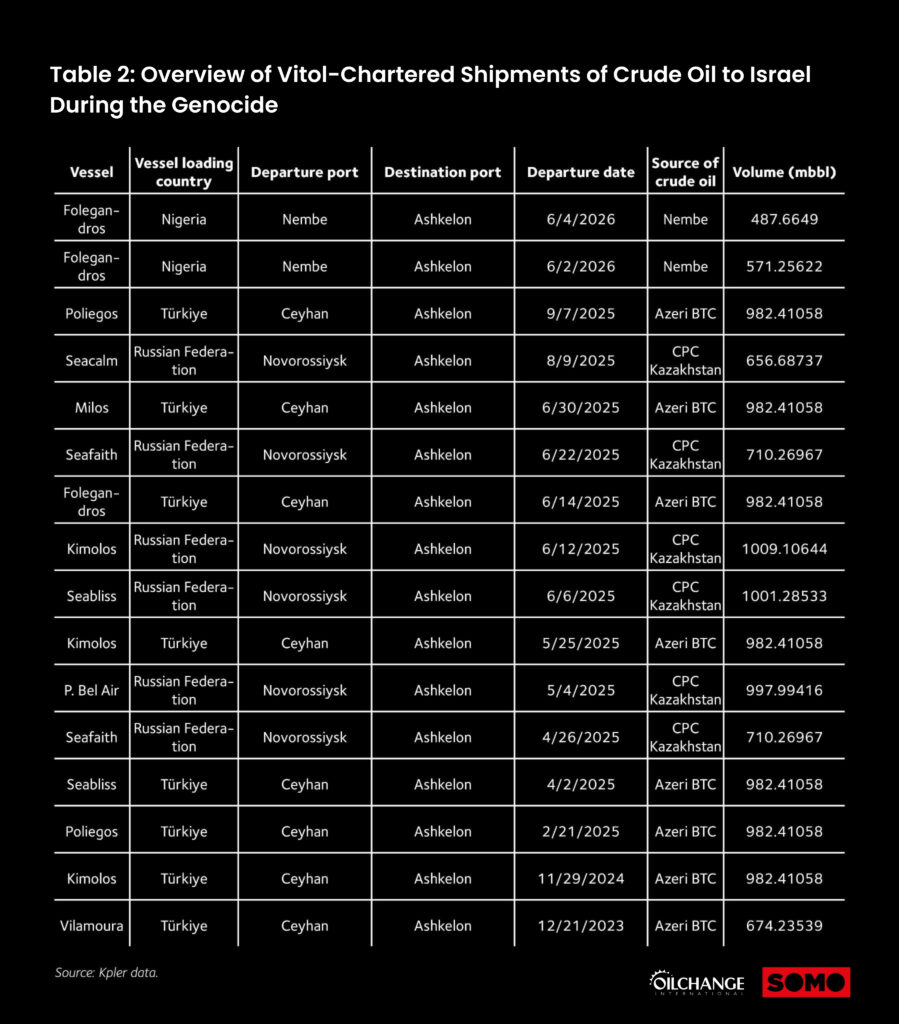
Between October 2023 and June 2026, Vitol brought almost 14 million barrels of crude oil to Israel through chartered shipment. All of the 16 crude shipments to Israel chartered by Vitol used vessels owned and managed by Greek companies, invoking Greece’s international legal obligations under the Genocide Convention and in relation to Israel’s unlawful occupation and settlements. Three Greek companies play a particularly large role: 9 of the 16 crude shipments use vessels that are managed by Kyklades Maritime Corporation and owned by subsidiaries of Okeanis Eco Tankers Corp. Five of the 16 crude shipments use vessels managed by Thenamaris Ships Management. Following a request for comment, Thenamaris stated it complies with international law and sanctions and as a policy does not comment on commercial or operational matters. Kyklades has previously responded to media(opens in new window) about its vessel ownership role, stating that it did not comment on “commercial operations” but that it followed all international laws and applicable sanctions.
Between April and July 2025, Vitol significantly increased its crude oil shipments to Israel, with volumes climbing from 1.7 million barrels in April to 2 million in May and reaching almost 5 million in June. The short period of increased imports coincides with the run-up to Israel’s attack on Iran on 13 June 2025 and the extension of a long-running secrecy order(opens in new window) banning the disclosure of key business dealings of the EAPC.
Vitol’s long history of corporate controversy
Vitol’s decision to deliver crude oil to Israel during the genocide in Gaza is not the first time the company has been accused of unethical behaviour, including actions that enabled it to profit from war, conflict, and unlawful military action:
2026: Vitol secured the first U.S.-authorised sale(opens in new window) of Venezuelan crude oil following the U.S. military kidnapping Venezuelan President Nicolás Maduro and taking control of the country’s oil sector. The crude shipment was initially destined for Israel, where it arrived in early March 2026 – days after Israel and the United States started their attack on Iran – but departed Israel without offloading(opens in new window) . A senior Vitol trader involved in securing the contract had made political donations to support Donald Trump’s election campaign. He also met with the president days before the agreement was finalised. He reportedly stated that Vitol would attain the best price possible for Venezuelan oil for the United States, so that, as he addressed to Trump, “the influence you have over the Venezuelans will ensure that you get what you want”. In its response to SOMO and OCI, Vitol wrote that the trader concerned “made political donations in his personal capacity” and “has since retired from Vitol”.
2025: In addition to crude oil, Vitol has provided jet fuel directly to Israel, potentially in a moment of supply shortage. On the night of 14 to 15 June 2025, an Iranian strike (opens in new window) targeted and damaged the Haifa refinery, resulting in at least one crude distillation unit going offline(opens in new window) until late August of that year. Several days after this event, on 18 June, a shipment of Jet A-1 fuel, chartered by Vitol, departed from the Dangote refinery in Nigeria and arrived in Israel in July. According to Kpler data, this was the first shipment of Jet A-1 fuel to Israel since July 2022. The timing of the shipment from Nigeria raises questions about whether Vitol’s charter of Jet A-1 was a swift response by the company to meet Israel’s need to fill a gap in supply following the Iranian attack.
2023: While EU sanctions(opens in new window) had banned the import of Russian crude oil and refined petroleum products, Vitol was accused(opens in new window) by the NGO Global Witness of sourcing 900,000 barrels from Turkish refineries known to import Russian crude oil in the first two months following the EU sanctions alone. In response to OCI and SOMO, Vitol said that “it has long been the case that the origin of petroleum products derived from a crude oil is defined by the country in which they were refined, not the origin of the crude oil.”
2012: Vitol reportedly(opens in new window) acted through a Bahraini branch of the company to buy two million barrels of Iranian oil from a non-Iranian counterparty, after the entry into force of the EU sanctions on buying and selling Iranian oil and shortly before the U.S. sanctions on Iranian oil came into force. At the time, it was reported(opens in new window) that Vitol was not obliged to comply with a ban imposed in July by the European Union on trading oil with Iran because Switzerland, where Vitol has an office, decided not to match EU and U.S. sanctions against Tehran. In a response to SOMO and OCI, Vitol maintained that the company’s “actions were fully compliant with international sanctions”. The company did not address the issue of EU sanctions but stated that “[t]he transaction was executed (with a non-Iranian counterpart) prior to the signing of Executive Order 13622 which came into effect on 30th July 2012.”
2007: Vitol pled guilty(opens in new window) to first-degree grand larceny for providing $13 million in kickbacks to the Iraqi state oil company under Saddam Hussein in order to win oil supply contracts. Vitol paid $13 million(opens in new window) in restitution to Iraq and $4.5 million in lieu of fines, forfeiture, and to cover prosecution costs. In response to SOMO and OCI, Vitol specified that the first-degree grand larceny to which it pleaded guilty following the Manhattan (NY) District Attorney’s Office charges concerned payments made to the Iraqi state-owned oil company State Organisation for Marketing of Oil.
Responding to SOMO and OCI’s request to comment, Vitol refuted the existence of war or conflict in Venezuela (in 2026) and Iran (2012), and claims it has not profited from war and conflict in Venezuela, Ukraine, Iran, or Iraq. Vitol did not comment on its identification as a charterer of crude oil shipments to Israel or the legal implications thereof.
Heritage – suddenly a top trader to Israel
Heritage Petroleum FZCO is new among the oil traders and has quickly become one of the top suppliers of crude oil to Israel. The company was founded (opens in new window) in December 2023 in Dubai. Little is known about Heritage, which maintains a very basic website(opens in new window) and a dormant LinkedIn page(opens in new window) . It is located in the Dubai Multi Commodities Centre (DMCC), a free trade zone consisting of 87 high-rise towers where approximately 26,000 companies enjoy high levels of secrecy, zero per cent personal income tax, and a potential zero per cent corporate tax rate on qualifying income.
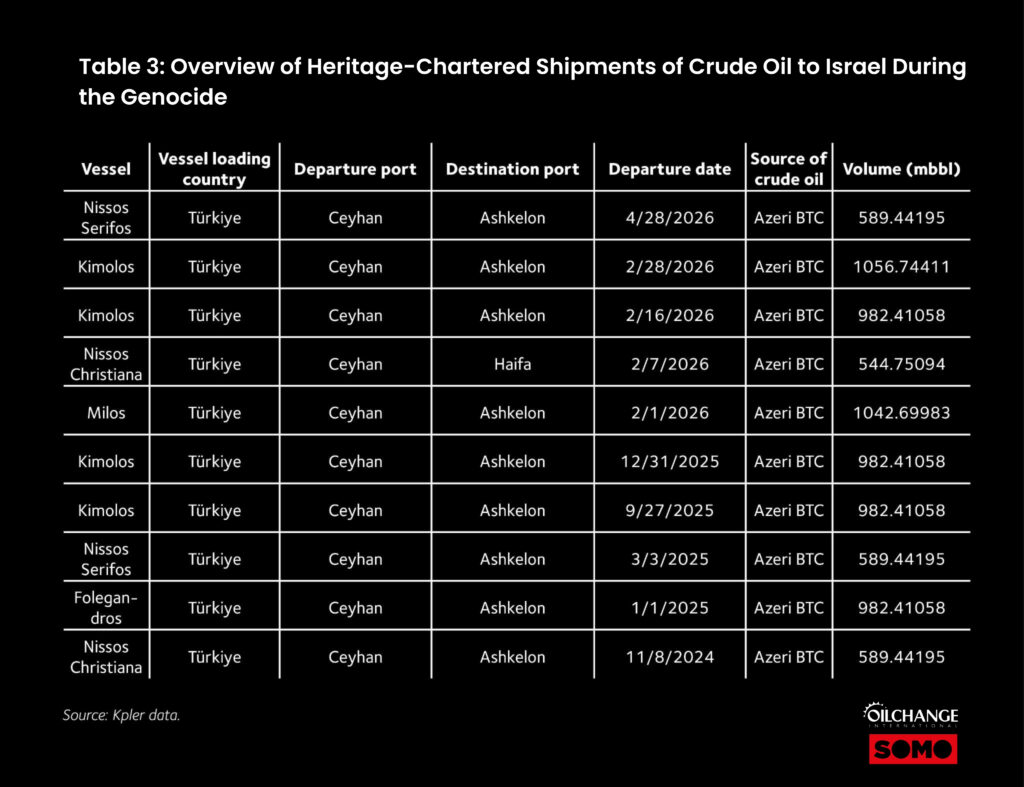
According to Kpler data, Heritage began chartering crude oil shipments to various destinations in June 2024, with all shipments originating from Türkiye. The oil is likely to have come from Azerbaijan as it was from the Baku-Tbilisi-Ceyhan (BTC) pipeline, which delivers crude from Azerbaijan to Türkiye. Heritage chartered its first crude oil shipment to Israel in November 2024. Since then, Kpler and LSEG data indicates that the company has chartered 8.3 million barrels of oil to the country across ten shipments, becoming Israel’s second-largest charterer of crude oil shipments to Israel over the past year (July 2025 to June 2026).
Heritage maintained a steady crude oil supply to Israel throughout 2025, with shipments in January, March, September, and December. In 2026, the tracking data shows that it chartered shipments in February and April, with a peak in February, when it made four deliveries to Israel. Nine out of ten of the recorded Heritage shipments to Israel went to the Israeli-state-owned Europe Asia Pipeline Company (EAPC) in Ashkelon. One shipment went to Oil Refineries Limited (ORL) in Haifa. The vessels used in these shipments were owned and managed by companies headquartered in Greece: all of the ten crude shipments to Israel which are reported to have been chartered by Heritage used vessels managed by Kyklades Maritime Corporation, and six of the shipments used vessels owned by subsidiaries of Okeanis Eco Tankers Corp.
Of potential concern to Türkiye as it has banned trade with Israel, Heritage owns two shipping services companies registered in Istanbul: Shiptech Maritime Ltd. and Limosa Trading Logistics Inc.
Shiptech Maritime was founded in March 2022, according to the Turkish trade registry. In June 2024, Heritage became the company’s sole shareholder. On its website(opens in new window) , Shiptech Maritime advertises itself as a provider of shipping services operating across several Turkish ports and terminals, including Ceyhan.
As of September 2024, Heritage became the single shareholder of Limosa Trading Logistics Inc., an Istanbul-registered shipping services company established by a Turkish shipping company in May 2023.
Limosa Trading Logistics advertises itself(opens in new window) as a “strategic partner for petroleum and petrochemical trading and logistics.”
On 2 May 2024, Türkiye’s Ministry of Trade announced that it had suspended all trade with Israel as a direct response to Israel’s crimes in Gaza. Yet, as noted above, Kpler data show that just six months later Heritage began chartering crude oil to Israel, with all shipments departing from Türkiye. According to Reuters(opens in new window) , in November 2024 Türkiye claimed that exporters using Ceyhan port “respected its decision to end trade with Israel” and that oil was not being loaded with Israel as the destination. However, Kpler data and further media reporting(opens in new window) suggest that Turkish authorities may not be enforcing the export ban.
An additional question arises about whether Turkish companies that enable export of goods to Israel fall within the boundaries of the country’s export ban. It is not clear whether Shiptech and/or Limosa play a role in Heritage’s oil trade from Türkiye to Israel. However, if they were to directly support Heritage’s chartering of crude oil bound for Israel with loading and tugboat or other services in Turkish ports, this would be enabling a prohibited activity, and should be investigated further.
Replying to SOMO and OCI’s request for comment, Shiptech on behalf of itself and Heritage, stated that neither Shiptech nor Heritage were violating Türkiye’s trade ban and were never “engaged in the sale, purchase, transportation or trading of crude oil with Israel”. Shiptech did not comment on whether the company was involved in providing shipping services in Turkish ports for chartered shipments of crude oil bound for Israel. Following up on this communication, SOMO and OCI wrote to Shiptech detailing the different data sources for the findings: Kpler and LSEG data confirm Heritage’s chartering of crude oil shipments to Israel. Inspection data from Port State control records Heritage as the charterer of some of the vessels around the time of the relevant shipments to Israel. Satellite imagery confirms that several of the identified vessels docked and offloaded at Israeli ports at relevant times. Shiptech declined to comment further.
Stop oil shipments to Israel
Israel has been widely and credibly reported to be committing crimes under international law, including the crime of genocide(opens in new window) against the Palestinians in the Gaza Strip, while maintaining an illegal occupation, apartheid regime, and unlawful settlements(opens in new window) in the Palestinian territory(opens in new window) . Israel’s military is central to the commission of these crimes. States and private actors that supply goods or services to Israel, which can reasonably be supposed to enable the commission of these crimes or enable them to be carried out on a larger scale than would otherwise be the case, may themselves be complicit. At the very least, they are knowingly supplying, or allowing the supply of, material that can contribute to the commission of crimes.
States that allow the supply of materials which can be used for military purposes may also be in breach of their legal obligations(opens in new window) , under the Genocide Convention, to “employ all means reasonably available to them, so as to prevent genocide so far as possible”. Additionally they would be acting against the July 2024 determination of the International Court of Justice, which made clear that states must “abstain from entering into economic or trade dealings with Israel […] which may entrench its unlawful presence in the territory”, and must “take steps to prevent trade or investment relations that assist in the maintenance of the illegal situation created by Israeli in the Occupied Palestinian Territory”.
Fuel is a necessary component of most of the unlawful acts committed by Israel detailed above. The military cannot operate without fuel. Israeli institutions cannot perpetuate genocide, apartheid, and illegal occupation without fuel. An important source of fuel in Israel, including for the military, is imported crude oil, which is refined in domestic refineries.
To comply with their obligations under the Genocide Convention and adhere to the ICJ’s weighty recommendations on trade and economic relations with Israel vis-à-vis its occupation of Palestine, states should prevent the export and transport of oil to Israel. While crude and refined oil have legitimate civilian uses, in the context of Israel’s unrelenting commission of crimes under international law, the clear link between imported crude oil and the supply of fuel to the military, and the equally clear evidence of the military’s use of fuel to maintain the unlawful occupation and commit atrocities, the legitimacy of curtailing the flow of oil is also clear.
States have multiple levers to curtail and prevent shipments of oil. These include, but are not limited to, exercising their jurisdiction and legitimate leverage over oil companies and the host of enabler companies involved in the oil trade to stop transfers to Israel.
This briefing has exposed the role played by oil commodity traders as the charterers of vessels that transport crude oil and the companies that service oil shipping. They include companies operating in Türkiye, a state that has banned trade with Israel but apparently has not effectively enforced this ban, as well as companies based in Greece and the United Arab Emirates. All states should take effective regulatory measures to ensure that corporations domiciled in their jurisdiction cannot trade or facilitate the shipment of crude oil to Israeli refineries. More specifically:
Countries which are home to entities that facilitate oil trading, such as the United Arab Emirates, Greece, Russia, the United Kingdom, Switzerland, and Luxembourg should establish prohibitions on facilitating any form of trade or transport of oil to Israel as an action to give force and effect to their obligations under international law.
- Azerbaijan, Kazakhstan, Nigeria, and all other oil exporting countries should impose an oil embargo on Israel, and must ensure contractually, for example through an end user declaration, that companies buying their oil do not supply or facilitate supply to Israel.
- Türkiye should take robust measures(opens in new window) to enforce its trade ban including by preventing the transit of crude via its territory if it is destined for export to Israel’s refineries. It should not allow companies to facilitate the transit, docking, and servicing at their ports of vessels carrying or getting loaded with crude oil destined for Israel.
- Countries which are home to entities that facilitate oil trading, such as the United Arab Emirates, Greece, Russia, the United Kingdom, Switzerland, and Luxembourg should establish prohibitions on facilitating any form of trade or transport of oil to Israel as an action to give force and effect to their obligations under international law.
This briefing has named only a small, albeit important, number of companies involved in oil trading and chartering to Israel. Greater transparency on the many other companies, almost certainly spread over many more countries, involved in the oil trade would allow more states to act. OCI, SOMO, and many others have called for an embargo on oil to Israel. It is only by identifying the vast web of companies that are currently enabling the deliveries that such an embargo can be enforced. Conversely, each avenue or route for oil transfers that is shut down adds to the pressure to end the grave abuses Israel continues to perpetrate.
While much of this briefing is addressed to states, the companies involved are put on notice. Companies cannot hide behind the inaction of states. Under international criminal law, companies and corporate executives providing material support, such as crude oil that is refined and which the Israeli army uses in the commission of these violations could be held liable as “accomplices”, where that supply has a “substantial effect” on the commission of those crimes and they were aware of the substantial likelihood of this happening.
Regulatory action aimed at depriving Israel of the fuel supply that sustains its violations of international law is both key and long overdue.
Download this report
Do you need more information?
-

Lydia de Leeuw
Strategic Litigation Lead
Related news
-
 Norwegian court green lights class action lawsuit against telecoms giantPosted in category:NewsPublished on:
 -
 Proposed Tata Steel subsidy may rise to €11 billionPosted in category:News
 Joseph Wilde-RamsingPublished on:
 -
Different energy resources; same race to the bottomPosted in category:Opinion
 Sara FleischerPublished on:
Sara Fleischer
Sara FleischerPublished on:
Sara Fleischer