

Unleashing terror: Dutch dogs in Israel’s war crimes
⚠️ Trigger warning: This article contains descriptions of extreme violence, including attacks by military dogs, physical abuse, and psychological trauma. It features testimonies from victims, some of which describe violence against children.


Summary
-
The Israeli military systematically uses dogs to brutalise Palestinians, including children, elderly people, and detainees, sometimes with fatal consequences.
-
New evidence obtained by SOMO reveals a significant risk that police dogs exported from the Netherlands are used by the Israeli army in international law abuses.
-
The Genocide Convention obliges the Netherlands to take action to prevent genocide. By allowing the export of military dogs to Israel to continue, the Netherlands is failing to abide by its international legal obligations.
It’s early 2024 in Nablus, occupied West Bank. Amna’s three-year-old son Ahmad is sleeping in her arms as she gets her other children ready for school. Suddenly, Israeli soldiers force their way into her home with a large police dog. The dog attacks Amna and Ahmad, clenching its jaw around the toddler’s buttocks for several minutes. “I could hear my son scream in pain and my daughters were shrieking and crying out of fear and terror,” Amna recalls. The soldiers drag the dog and Ahmad down the stairs and out of the building, hitting Amna with the butt of a rifle to stop her from reaching Ahmad. When the soldiers return Ahmed to his mother, he is “unconscious, wrapped in a bloodied foil blanket.” Ahmad is hospitalised for eight days and needs 42 internal and external stitches, while Amna’s other children suffer “severe psychological trauma after everything they witnessed.”
From Gaza to the West Bank, from Palestinian homes to Israeli detention centres, Palestinians have shared horrifying testimonies of dog attacks by the Israeli military. These testimonies demonstrate the Israeli military’s systematic use of dogs to brutalise Palestinians, including children, elderly people, and medical staff – sometimes with fatal consequences.
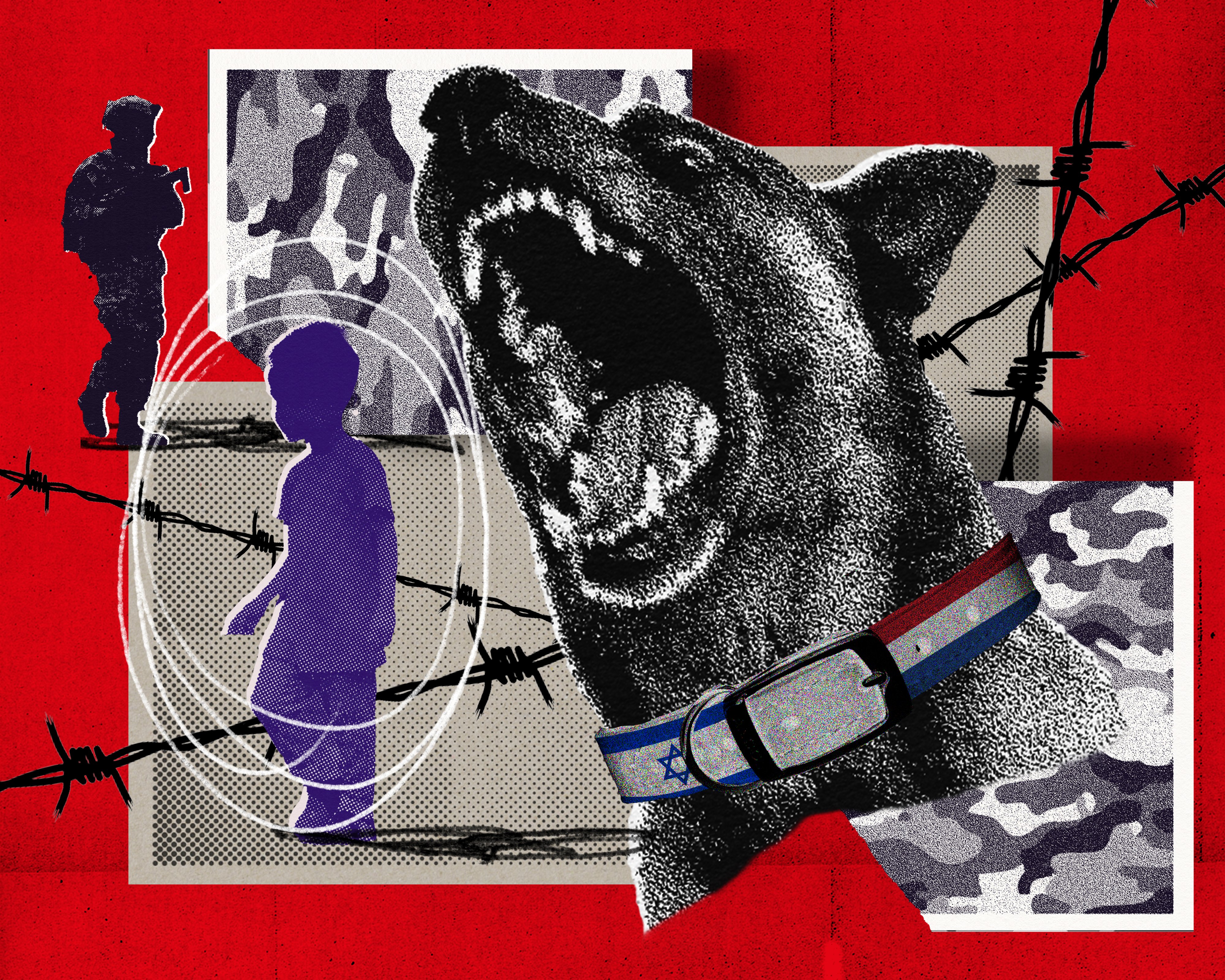
Reportedly, the Netherlands is a key country from where police-trained dogs are exported to the Israeli army , but corporate confidentiality means that no public information is available about the suppliers or the number of dogs supplied to the Israeli army by Dutch companies.
SOMO discovered that police dog companies in the Netherlands obtained the required veterinary certificates for the export of at least 110 dogs to Israel between October 2023 and February 2025. One hundred of these certificates were granted to the company Four Winds K9, a police dog training centre in the southern Dutch village of Geffen.
Four Winds K9: the past coming back to bite?
Four Winds K9 has a decades-long history of exporting dogs to Israel. This history is tainted by unlawful dog attacks perpetrated by Israeli soldiers against Palestinians. SOMO obtained leaked documents relating to a past lawsuit against Four Winds K9. They show how the Israeli government went to great lengths to protect its supplier:
Leaked emails: How Israel shielded Dutch dog company from legal accountability
A few days before Christmas in 2016, the owners of Four Winds K9 receive a letter from Liesbeth Zegveld, a Dutch human rights lawyer, informing them that the dogs they supplied to the Israeli military were used in an unlawful attack on a Palestinian child and that the company will now be held liable for the damages suffered as a result of the attack. In 2014, soldiers from the Israeli army’s canine unit – the so-called Oketz (“Sting”) unit – let loose two of their dogs to attack a group of young Palestinians in Beit Umar, a village in the West Bank. Hamzeh Abu Hashem, then 16 years old, was attacked and bitten in his leg, arm, and shoulder. The soldiers filmed themselves(opens in new window) shouting insults at the boy and instructing one of their dogs to “Bite him!” Hamzeh sustained severe physical injuries as well as psychological trauma and persisting anxiety.
This attack was not an isolated incident. As the letter notes, it is “standing practice” for the Israeli army to use dogs to attack Palestinian civilians in the occupied Palestinian territory. “You know your dogs are used against Palestinians and that they do, in fact, attack and bite,” the letter states.
Four Winds K9 reportedly supplied 90% of the dogs used by the IDF (Israeli army) at that time.
In 2017, Zegveld files suit against Four Winds K9 for Hamzeh’s injuries caused by the dogs they provided to the Israeli army. On 31 October 2017, the owners of the company receive a summons letter to appear in court on 6 December.
A few days after receiving the summons letter, Four Winds K9 send a letter to the Israeli Ministry of Defence asking them to find the company “a qualified and trustable Dutch lawyer” and assist in bearing “the costs for this lawyer and further law costs.” In the view of the company owners, such support was only fitting. “Because of our long-lasting relationship (almost 25 years) we hope and expect that your government will assist us with the necessary support to solve this case.” In their letter to Israel’s Ministry of Defence, the owners express concern that, if the court finds in favour of the plaintiffs, “the supply of working dogs [to Israel] will be stopped”.
First pick
The summons letter causes panic not only at Four Winds, but also within the Israeli government, as reflected in leaked emails exchanged between the Israeli Ministry of Defence, the Israeli Ministry of Justice, and two law firms. After being alerted to the court case, several senior Israeli government officials, including a deputy general counsel at the Ministry of Defence, get involved in the Four Winds K9 case, along with two Dutch law firms: Wladimiroff Advocaten and Florent. The Hague-based law firm Wladimiroff Advocaten represents Four Winds K9 in the negotiation with the victim’s lawyers. Amsterdam-based law firm Florent functions as a liaison between Wladimiroff Advocaten and the Israeli government and advises the Israeli government on the implications of the case.
Internal emails show that a reason for the Israeli Ministry of Justice to weigh in on the dispute is that the Ministry of Defence considers it “very important to maintain the relationship” with Four Winds K9, as “this company has been a major supplier of dogs to the Oketz unit for about 25 years” and “allows the IDF first choice in selecting the dogs”.
The Israeli government proceeds to provide input on several drafts of the settlement agreement. As the settlement agreement nears finalisation, Florent and the Israeli Ministry of Justice exchange several emails about awaiting a “green light” from the Ministry of Defence on the agreement. On 12 June 2018, the Ministry of Justice emails Florent: “MoD has given its approval. You can give [lawyer at Wladimiroff] a green light!” On 8 October 2018, the settlement with Four Winds K9 is made public(opens in new window) : the company agrees to pay an undisclosed sum to Hamzeh and his father.
Systematic weaponisation of dogs
In the years since the Four Winds K9 lawsuit in 2017, the human rights risks of selling dogs to the Israeli army have only increased. Reports from human rights organisations, media, and the United Nations(opens in new window) show that the attack suffered by Hazmeh in 2014 is just one example of a systematic pattern of abuse, whereby the Israeli army, police, and prison services frequently use dogs to threaten and attack civilians, including toddlers, the elderly, and persons with disabilities. Dogs are also used to torture imprisoned Palestinians, including, according to media reports, through rape.
SOMO received sixteen victim and witness testimonies collected by Palestinian human rights organisations Al-Haq and Al Mezan, describing different types of dog attacks by the Israeli army since October 2023. These testimonies paint a gruesome picture of the ways in which dogs are used to brutalise Palestinian civilians.
Bitten, beaten, threatened: Testimonies of dog attacks in detention
A 77-year-old man from Gaza who was detained by the army described how some “of the most horrifying days” during his month-long detention were the four nights where, at 11:00 pm sharp each night, soldiers ordered detainees to “lie face down on the ground and spread our legs” and commanded the dogs to attack them. He recalled that a dog “bit my right hand and dragged me out of the room to where the soldiers had been waiting. They assaulted me, punching me [sic] and beating me with batons. One of them hit me in the stomach. I was frightened and in excruciating pain.”
An ambulance driver who was detained along with other health workers during a raid on a Gaza hospital shared a similar account: “The Israeli soldiers would routinely order us to lie face down on the ground and unleash their dogs, which attacked us. One detainee was bitten on the thigh, another on the shoulder. In our faith, it is not permissible to be touched or licked by a dog; this would necessitate washing. The soldiers knew this.” The ambulance driver recalled how dogs were used in torture: “Another soldier brought along a dog, which he fed in front of me while I was being interrogated. He signalled to me that he would unleash the dog if I did not confess. […] We could barely move due to the intensity of the beating, but if we did – when they brought in dogs – we would be kicked in the face with their boots even harder.”

In July 2024, the UN Office of the High Commissioner for Human Rights (OHCHR) released a report(opens in new window) on the situation of Palestinians in Israeli detention. Palestinians released from Israeli detention told OHCHR how Israeli forces “subjected detainees to violence and humiliation in a systematic manner, including through repeated serious physical assaults, setting dogs on the detainees, in some cases resulting in attacks and bites, and widespread threats and insults.”
Dogs as weapons during home raids by the army
The Israeli army continues to use dogs to attack Palestinians in their homes. A man from Gaza recounted an attack on his family in their home in December 2023: “About six soldiers were torturing me. They used offensive words to address me, telling me, “You are bastards.” I slept on broken glass; my blood was everywhere. I felt I was losing my memory a bit more each hour. When I asked for water, they poured it on my head. They unleashed three dogs, which licked the blood from my body, and they put out cigarettes on my back.”
Dogs: pets or weapons?
The export of military dogs is largely unregulated and falls under the same administrative procedures as the exporting or moving abroad of domesticated household pets.
The 2014 attack against Hamzeh brought national media attention to Four Winds K9 and led several Dutch parliamentarians to call(opens in new window) for an immediate halt to the export of dogs to the Israeli army. This prompted the Dutch government to explore(opens in new window) a dual-use export license regime applicable to dogs set for export to Israel. Under such a system, goods and animals that can be used for both civilian and military purposes would require an export license, with the state assessing the human rights risks of such exports before granting a license. Despite the clear human rights risks, the Dutch government decided(opens in new window) not to introduce such a licensing regime. Even today, with increasing evidence of abuses and renewed calls by parliamentarians to prevent dog exports to the Israeli army, the Dutch government remains reluctant(opens in new window) to address the risk of Dutch dogs being used in unlawful attacks by Israeli forces.
Dutch Government taken to court over dog exports
The Netherlands reportedly continues to be an important country of origin of dogs for the Oketz unit . In January 2024, the Israeli Ministry of Defence announced(opens in new window) a major procurement operation with trusted suppliers of trained dogs based in the Netherlands and Germany.
SOMO asked the Dutch customs authority for an aggregated, anonymised breakdown of export figures of dogs exported to Israel, specifically the Israeli Ministry of Defence, by private actors and – if applicable – the Dutch Ministry of Defence. The customs authority responded to SOMO in an email on 17 February 2025, saying that it could not share this information, even in an anonymised or aggregated form, due to “privacy regulations”.
However, SOMO was able to obtain information from the Netherlands Food and Consumer Product Safety Authority (NVWA) showing that, between October 2023 and February 2025, the NVWA issued 110 veterinary certificates required for the export of dogs by Dutch military/police dog companies to Israel. Of these 110 certificates, 100 were issued to Four Winds K9. Another four certificates were issued to Police Dogs Centre Holland, and six were issued to K10 Working Dogs.
On 17 March 2025, SOMO approached Four Winds K9, Police Dogs Centre Holland, and K10 Working Dogs for information about (i) the identity of their Israeli purchasers, (ii) the usage of dogs by these purchasers, (iii) how they ensure their dogs are not used in international law violations, and (iv) whether they ever received information from the Dutch government – before or after 7 October 2023 – about the legal risks of supplying police dogs to Israel. To date, none of the companies have responded to SOMO’s inquiries.
Lawsuit to halt Dutch export of military dogs
Under Dutch law, companies and corporate leaders exporting dogs to the Israeli army can be held criminally liable when their supply of dogs enables and/or exacerbates war crimes or acts of genocide committed by the Israeli army.
But there are also clear legal obligations for the Dutch State to prevent that dogs exported from the Netherlands are used in violations of international law by Israel.
On 26 January 2024, the International Court of Justice (ICJ) concluded that there was a plausible risk of Israel committing acts of genocide in Gaza. The Genocide Convention obliges the Netherlands to take action to prevent genocide.
On 19 July 2024, the ICJ determined that Israel’s occupation of the Gaza Strip and the West Bank, including East Jerusalem, is unlawful, and must be ended. The Court made clear that third states have an obligation to “take steps to prevent trade or investment relations that assist in the maintenance of the illegal situation created by Israel in the Occupied Palestinian Territory”.
SOMO and nine other Palestinian and Dutch civil society organisations are suing the Netherlands over its role in facilitating Israel’s violations of international law, including the illegal occupation of Palestinian territory and plausible genocide committed against the Palestinian people in Gaza. One of the demands in the case, which is now in appeals phase, is a halt to the export of (military) dogs to Israel or, alternatively, the imposition of a dual-use export license regime on dogs to Israel. The appeals hearing in the case is expected to take place in the Summer of 2025.
“The Netherlands is doing too little to prevent the export of weapons and dogs to Israel. Dogs are used to threaten and bite Palestinians. This has to stop,” says Christiaan Alberdingk Thijm, lawyer for the organisations in their case against the State.
The appeals hearing in the case is expected to take place in the Summer of 2025.
Note: Some of the quotes in this article have been translated into English from Hebrew or Dutch.
SOMO’s pro-bono corporate research desk, The Counter, contributed to this story.
___________________________________________
Update:
On 10 April 2025, during a foreign affairs debate in the Dutch Parliament, MP Christine Teunissen raised(opens in new window) SOMO’s investigation into the use of Dutch dogs by the Israeli military.
Shortly after, the Dutch Parliament passed a motion calling on the government to:
- Push for EU-level controls to include police dogs on the dual-use export list, and
- Explore all other possible measures to end the export of dogs that can be used as attack dogs by Israel.
In the coming weeks, the Minister of Foreign Affairs is expected to respond with the government’s position.
Read the full motion here(opens in new window) .
Support our work
Would you like to support investigative research that challenges unjust corporate power? We do action-oriented research to expose corporate harms, debunk myths, and unlock new alternatives.
Your contribution helps us stay independent, factual, and bold.
Do you need more information?
-

Lydia de Leeuw
Strategic Litigation Lead -

Maria Hengeveld
Corporate Researcher
Related news
-
The Telenor Myanmar scandal: a stark warning for data control in authoritarian timesPosted in category:Opinion
 Joseph Wilde-RamsingPublished on:
Joseph Wilde-Ramsing
Joseph Wilde-RamsingPublished on:
Joseph Wilde-Ramsing -
 Levi’s sued over misleading claims on labour conditionsPosted in category:News
 Aintzane MárquezPublished on:
 -
 Updated Datahub shows 1,400 corporate groups covered by weakened CSDDDPosted in category:News
 David Ollivier de LethPublished on: