
Fast-tracking Big Tech Power
How the tech industry is driving EU data centre policy
Key findings:
- Big Tech and other major businesses influenced EU plans to fast-track data centre expansion across the region, pushing for easier permits, faster grid connections, and weaker environmental constraints.
- Corporate access dominated the process. Between December 2024 and the Cloud and AI Development Act (CADA) proposal in June 2026, data centre policies attracted 367 recorded lobbying encounters with 160 entities. Microsoft, Amazon, and Google were among the most active lobbyists.
- Big Tech messaging was well aligned with those of allied industries such as data centre co-location firms and associations, and data centre suppliers.
- The alternative proposals from smaller businesses, academics, and public authorities are largely absent from the final Commission text.
- The “AI race” narrative presents expansion as inevitable. This is a red herring: it will create further digital dependence, locking corporate priorities into EU policy, while sacrificing environmental safeguards and climate change ambitions.
“Your cloud dries my river”
This is just one of the complaints a grassroots group(opens in new window) in Spain has made about the buildout of data centres in its local area. It has become the name of a growing movement in the drought-prone region of Aragón, which is at the centre of a Europe-wide struggle over the future of data centres.
Data centres are the infrastructure powering cloud and AI services, and the stakes for Big Tech couldn’t be higher. For years, the government of Aragón has courted investment from US Big Tech and data centre co-location companies , granting these projects the status(opens in new window) of projects of common interest (Planes y Proyectos de Interés General de Aragón – PIGAS). This status fast-tracks planning and permitting procedures, allowing land and environmental permits in less than 12 months. It can also facilitate faster land expropriations and tax breaks.
The region’s politicians want Aragón to become the Virginia of Europe(opens in new window) – a reference to the US state with the highest concentration of data centres in the world. The plan seems to be working for companies like Amazon and Microsoft.
A PIGA awarded to Amazon to expand their data centres in the region has become a focal point(opens in new window) for opposition and critique. The plan has drawn lawsuits from residents(opens in new window) , municipalities(opens in new window) , and local and environmental associations(opens in new window) .
Their are both extensive and very serious. And they are not alone in Europe. From congested electricity grids(opens in new window) and rising energy prices(opens in new window) , to the destruction of nature(opens in new window) and derailed climate targets(opens in new window) , the costs of the data centre build-out are becoming increasingly clear across the continent. This hasn’t stopped Microsoft(opens in new window) and Amazon(opens in new window) from using Aragón as a showpiece in their efforts to shape EU rules for data centre development.
Our research shows that Big Tech, data centre operators, and major European businesses have been prominent in shaping the EU’s policy response to data centre expansion, including the Cloud and AI Development Act (CADA) and the data centre labelling scheme. The resulting proposals prioritised rapid expansion over sovereignty, democratic participation, and sustainability.
What is happening in Aragón is a forewarning of what could happen across Europe.
A process dominated by big business
The sheer scale of the ongoing data centre build-out is difficult to imagine. Big Tech has spent eye-watering amounts of money on digital infrastructure. In just three years, Google, Amazon, Microsoft, and Meta have reportedly invested(opens in new window) $1 trillion in AI, mostly into the data centres powering the technology.
For these companies, data centre capacity underpins their cloud businesses, AI services, and future revenue growth. Decisions about permitting, electricity access, and environmental standards can directly affect their ability to expand, their costs and their competitive position. That’s why EU-level lobbying on these issues is a key battleground for Big Tech.
The rapid data centre build-out is also being felt across the EU. In March 2024, the European Commission took the first steps towards regulating the market by adopting(opens in new window) a sustainability rating scheme for data centres, which requires operators to report key sustainability performance indicators.
Despite the increasingly visible harmful local impacts of data centres, the Commission has since chosen to back their expansion. This became evident at the AI Action Summit in Paris in February 2025, attended by dozens of government leaders and business executives, where the Commission President stressed(opens in new window) the importance of winning the global ‘AI race’. Increasing computing capacity is a cornerstone of that ambition.
Analysis of lobby meeting data from the European Commission shows how quickly industry moved in. Proposals to regulate the data centre market in Europe, including the Cloud and AI Development Act (CADA) and the data centre sustainability rating scheme, were heavily lobbied. With the Commission set on expansion, corporate lobbyists found a receptive audience.
You can read our full methodology here.
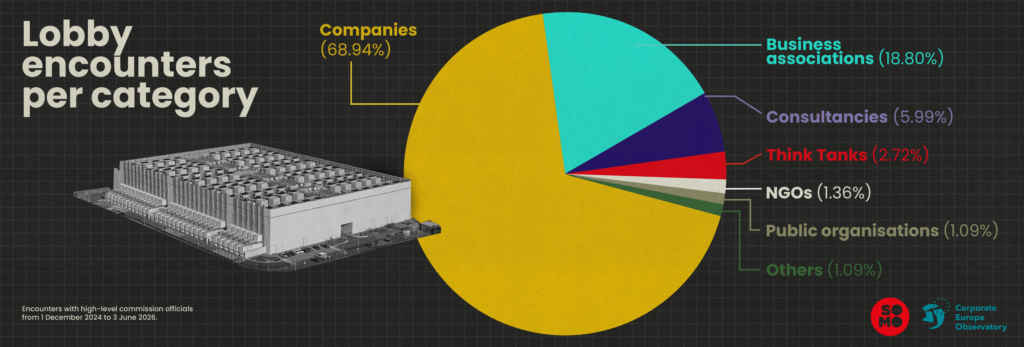
From the beginning of this Commission’s mandate on December 2024, until the publication of the CADA proposal on 3 June 2026, data centres policies attracted 367 recorded lobbying encounters involving 160 entities. By and large, corporate interests dominated this process: companies, their consultancies, and trade associations accounted for 93.73 per cent of all encounters, while communities and other public-interest voices had far fewer recorded opportunities to put forward their concerns.
Some businesses were more active than others. US Big Tech companies led the charge with Microsoft, Amazon, and Google combined racking up 41 encounters. Their message was in line with that of trade associations like the European Data Centre Association (EUDCA), which counts data centre operators and suppliers, plus US hyperscalers among its members(opens in new window) .
EU businesses were also well represented. Topping the list is Europe’s biggest cloud provider, the French OVH Groupe, whose voice was amplified(opens in new window) by the trade association European Sovereign Tech Industry Alliance (ESTIA). Smaller cloud providers were represented(opens in new window) by the Cloud Infrastructure Services Providers in Europe (CISPE). Other companies across the cloud and AI value chain, from the chipmakers equipment suppliers to the AI model developers, make up the rest of the top.
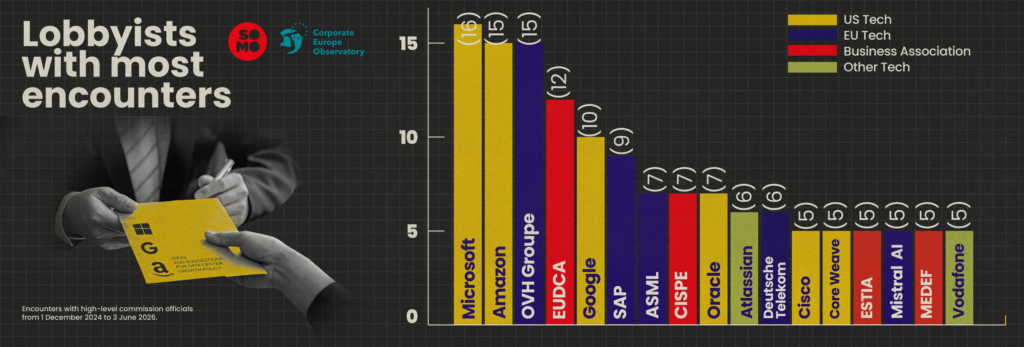
Source: SOMO and CEO analysis of European Commission meeting records. The percentages refer to recorded encounters.
Responding to our findings, a European Commission spokesperson said: that in the context of CADA, “it has engaged with civil society organisations, public authorities, researchers, and think tanks throughout the preparation of the initiative, and since its adoption.” To support its answer, the Commission pointed to two workshops held as part of the Cloud and AI study that backs the CADA proposal, which, according to the Commission, “brought together representatives of national ministries and public authorities, universities and research institutions, independent think tanks, industry representatives and civil society organisations, including environmental organisations specifically focused on the territorial, water and energy impacts of data centre development.” (Full response here.)
However, the impact assessment study(opens in new window) published with CADA shows that there were a total of 12 workshops held during this study, the vast majority of which included only industry, some even exclusively with with US tech associations.
Civil society representatives that attended the two workshops referenced by the Commission told us that these sessions mostly focused on presenting the methodology and results of the research, leaving little space for questioning the need or the objectives of the policies under consideration.
Kristina Irion, Associate Professor at the Institute for Information Law (IViR(opens in new window) ) at the University of Amsterdam, is also critical of the process that fed this study. From her perspective, it”collected its evidence predominantly from cloud computing providers, data centres’ developers and industry associations with occasionally a few public sector bodies, but civil society organisations were not invited to contribute.” As a result, she told us, the conclusions “fully support expanding data centres’ capacity as well as speeding up permissions for developers without due regard to the sector’s significant environmental footprint and impact on local communities”.
Aurora Gómez, member of the Aragón collective Tu Nube Seca Mi Río (Your cloud dries my river), told us that for the communities directly facing the impact of data centre policy, it is nearly impossible to participate in EU policy-making processes:
“There is a huge power imbalance between us and the data centre industry, which explains why we cannot play such a significant role in European politics. But that is not our fault; it is the fault of the European authorities themselves.”
Phase I: Setting the policy agenda
Access does not necessarily equal influence. However, comparing the demands of industry – especially from big companies – with the Commission’s final proposal, reveals a striking alignment: on key questions of permitting and environmental safeguards, the policy direction favoured by major industry players closely matches the approach advanced by the Commission.
Early ideas about increasing computing capacity in Europe mostly revolved around mobilising private and public investment to build more AI gigafactories.
In April 2025, more than one year before the Cloud and AI study was finished, the EU Commission published the AI Continent Action Plan(opens in new window) . Here the Commission announced for the first time the EU’s new approach: to triple data centre capacity in five to seven years by simplifying permitting and providing public support for data centre projects.
Several civil society organisations have raised(opens in new window) questions(opens in new window) about the need to triple data centre capacity. A freedom of information request by us showed that already in December 2024, in the tender for the CADA study, DG CNECT explicitly mentioned the need to triple data centre capacity in the EU “to have sufficient computing power for AI-related data storage and processing”. The tender reveals(opens in new window) the source for this claim was a report by the real estate industry that is also involved(opens in new window) in the data centre industry.
Between the start of the second von der Leyen Commission in December 2024 and the publication of the AI Continent Action Plan in April 2025, the Commission had already had 44 encounters with lobbyists, 90 per cent of which were with corporations and their trade associations.
The message from Big Tech at these meetings seems to be clear: we can be solid partners in achieving Europe’s AI ambitions, and the policy priority should be easing permitting and speeding up connections to the electrical grid.
Microsoft, for instance, sought meetings with the Commission during this period to discuss(opens in new window) about their “massive investment in data centres in Europe” and how they can help “grow European tech champions”.
Amazon was particularly active in February 2025, shortly after the AI Summit where President Von Der Leyen committed to win the ‘AI race’. First the company lobbyists met(opens in new window) with the cabinet of Commissioner Henna Virkkunen, where they raised “the difficulty in obtaining permits and access to energy as major obstacles to investments in data centres”.
Two days later, representatives from Amazon were back in a Commission building, this time to update(opens in new window) DG CNECT officials of its “past and upcoming investment related to the deployment of AI-ready cloud regions across the EU” and the challenges the company faces. The company also raised(opens in new window) the same concerns to DG GROW and concluded that a “Different approach [is] needed, to prioritise and simplify process for strategic investments.”
By the time the AI Continent Action Plan was made public, tripling data centre capacity had become the goal and permitting took the front stage. As is often the case, the most influential lobbying takes place before policy proposals are formally written down. It seems likely that the intense campaign from tech companies in this period determined the scope of what the EU deemed to be feasible and actionable. That situation favoured the corporate lobbyists, because once the direction of travel is set, it becomes much harder to reverse it.
Phase II: Commission’s ambition to triple data centre capacity opens the door to Big Tech
At this point Big Tech firms had a clearer policy target to influence. Amazon, Google, and Microsoft used this as an opportunity to influence a whole host of policies associated with data centres and the environment.
Microsoft went on the offensive against environmental permitting, both in the proposed CADA and the then-upcoming Environmental Omnibus. The company wrote(opens in new window) in October 2025 to the cabinet of the Commissioner for Environment, that the Environmental Omnibus – a law that, among other things, largely weakens environmental permitting rules – had become “a strategic priority” for the company. Microsoft added that in light of the Commission’s ambition to triple AI capacity in the region by 2030, “we see the streamlining of permitting procedures as a critical enabler”. Microsoft repeated the same point in meetings with Commissioner Roswall’s cabinet(opens in new window) , the Secretariat-General(opens in new window) , and DG CLIMA(opens in new window) .
Google also told(opens in new window) DG CNECT that permitting and energy were “barriers” to their investments.
All three US hyperscalers stressed the need to ease permitting rules in their consultation submissions. In its submission to the EU Commission Amazon wrote(opens in new window) , “From our perspective there are three areas that should be the focus in the Cloud and AI Development Act: 1) Improve access to information to speed up site selection, 2) Streamline and simplify grid connections, 3) Introduce fast-track permitting for datacenters.”
Microsoft(opens in new window) and Amazon(opens in new window) both pointed to the Aragón region as an example to follow.
Amazon and Google(opens in new window) also argued against linking the CADA legislation to new environmental criteria, including opposition to introducing new minimal performance standards – an upcoming EU initiative that would require data centres to comply with a minimum set of sustainability requirements.
In response to our findings, an Amazon spokesperson said: “Amazon engages on issues that are important to our customers, sellers, and the diverse range of businesses we operate. This means we work with organisations like trade associations, communicate with officials at the European institutions, and submit public consultation responses.”
Microsoft, in turn, stated that it “engages openly and transparently with policymakers on the Cloud and AI Development Act (CADA), including on the issues of energy policy and permitting.” and added that “As part of CADA, the EU has set ambitious goals to expand its cloud and AI capacity. This requires predictable permitting and timely access to electricity grids.” You can read the full replies here.
Limiting public participation and legal challenges
Google went further, asking(opens in new window) the Commission to restrict the right of affected communities to challenge data centre projects. It called for the Commission “to limit the legal right to object to immediate neighbours and only during the zoning process”, citing Austria’s example, where only people living within a radius of 50 meters can legally object to a permit.
To address community protests, derided as ‘NIMBYism’ (ie ‘Not in My Backyard’), Google suggested(opens in new window) that governments should “do a more effective job at conveying the vital importance of data centers to communities and the economy”. QTS, a US data centre co-location company, echoed this when in October 2025, it told(opens in new window) a DG CNECT Director that its investments in Europe were not only facing challenges when it came to accessing energy and permitting but also “social acceptance”.
A QTS executive landed in hot water when journalists from Lighthouse Reports released a video(opens in new window) of an industry conference where the executive referred to people opposed to data centres as “CAVE people”, according to him an acronym for “Citizens Against Virtually Everything”.
In response to this research, a QTS spokesperson said that “showing up, listening, and responding to local concerns is at the heart of QTS’ approach to projects where we live and work.” The company added that the executive’s comments were categorically “not a dismissal of legitimate community debate about data centres”. You can read the full reply here.
Alignment with co-location companies and big European businesses
Big Tech was not alone in seeing the Commission’s AI ambitions as an opportunity. Their positions were in line with those of the European Data Centre Association (EUDCA), which represents data centre operators and counts(opens in new window) Big Tech, European trade associations, and co-location companies – whose business is often shaped by contracts with US hyperscalers – among their members.
EUDCA agreed(opens in new window) with the Commission’s proposal to create one-stop shops for permitting, but also suggested introducing “fast-track procedures for certain projects”. This is not too dissimilar to the arrangement in Aragón.
The Association argued that these methods should not be limited to European players only. Preying on the Commission’s goal to enter the AI race, it argued(opens in new window) : “Without significant and strategic investments, including third-country investments, there is a risk that Europe will fall behind its competitors, notably in the AI race, and will not be able to reduce its external dependencies, while also potentially exposing itself to cybersecurity threats.”
In response to our questions, EUDCA said that “positions are set collectively by its European and international members.” You can read the full reply here.
Big European businesses also put forward messages that were closely aligned. The German company Siemens asked(opens in new window) for the EU to “Avoid lengthy permitting and long waiting times for grid connection” and further advised(opens in new window) the policy-makers to weigh energy efficiency goals against the need to make the EU attractive for investors.
French company Schneider Electric asked(opens in new window) “for accelerated permitting procedures”, describing the UK’s creation of ‘AI Growth Zones’ as an “inspiring initiative”. Both Siemens(opens in new window) and Schneider(opens in new window) supply technologies and infrastructure used in Big Tech’s data centres, giving them a direct interest in their expansion. Meanwhile, President Von Der Leyen appointed the Chair of Siemens as Special Adviser on Industrial AI, a move heavily criticised by lawmakers(opens in new window) and civil society organisations(opens in new window) , including Corporate Europe Observatory, for its inherent conflict of interest. An EU Ombudsman complaint filed(opens in new window) by Corporate Europe Observatory, LobbyControl, Transparency International EU, and The Good Lobby against the appointment is ongoing.
European companies that present themselves as alternatives to US hyperscalers, like German Deutsche Telekom(opens in new window) and French OVH Groupe(opens in new window) , also supported fast-tracking projects. However, both consistently pointed out(opens in new window) that the problem in the current European market is its heavy dependence on a small number of global players.
In a response to our queries, OVH said that “Europe already has competitive cloud providers, and CADA should turn that capability into scale rather than reinforce existing dependencies.” For the French company, “data centre deployment should be accelerated but should come with conditions. It should prioritise European-controlled capacity and sustainable projects, while strategic status should reward European value rather than size alone”. You can read the full reply here.
This shows that the policy choice is not simply between building more data centres and building fewer, but between different models of ownership, control, sustainability, and the distribution of economic value.
Phase III: Weakening the rating scheme used as a criteria for data centre acceleration zones
While lobbying to accelerate permitting through CADA, Big Tech and data centre co-location companies were waging a second battle: the Commission’s attempts to impose sustainability requirements that could constrain their expansion. Industry lobbyists seem to have been unified on the message that such requirements would be an obstacle to the data centre boom.
Research by Corporate Europe Observatory, AlgorithmWatch, and InvestigateEurope exposed(opens in new window) how the EU Commission copy-pasted an amendment suggested by Microsoft to keep environmental data secret. In response, Microsoft stated it has “published metro-level energy and water use for our owned data center operations in our 2026 Environmental Sustainability Report”, which is a markedly different approach to specific disclosure per data centre. You can read the full reply here.
But secrecy is only part of the story.
In June 2026 Politico reported that EUDCA’s chief stated(opens in new window) the EU must prioritise AI over its climate ambitions, including to allow data centres to power their operations with fossil fuels. In a reply to this research, EUDCA said that the statement does not represent their position, and that the association “has consistently maintained that Europe’s digital competitiveness and climate ambitions must advance together”.
Meeting minutes from October 2025 published(opens in new window) by the European Commission indicate that, at the very least, the association told policymakers that sustainability objectives were a challenge to the EU’s new goal of tripling data centre capacity. In that same meeting, the EUDCA went on to discuss the “difficulties they have with certain indicators” on the sustainability labelling scheme and the minimum performance standards for data centres. In comments(opens in new window) made to Politico, EUDCA said that the rating scheme would drive away investment.
EUDCA’s response to us said that its “recommendations sought to strengthen the proposed methodology and ensure that the scheme is fair, technically feasible and consistent with existing EU legislation”.
The Data Centre Climate Neutral Pact, an initiative from the data centre industry, also publicly opposed developments(opens in new window) with the EU’s data centre sustainability labelling scheme which it claimed would have “unintended consequences of which could damage Europe’s competition and growth agendas in the digital era”.
One of the disputed issues was the energy offsetting plans(opens in new window) whereby companies could buy certificates of renewable energy generation to compensate for their own use of dirty energy. The draft proposal stated that such schemes would only be accounted for if they originated from the same region and in the same time period the electricity was consumed. By the time the final labelling scheme was published(opens in new window) in September 2026, the time and geographic matching requirements had been deleted. This means a data centre running on dirty energy in Germany can simply buy renewable energy certificates generated from Spain (or any other geography) from any time period, and still be labelled as green. The confidentiality provision associated with Microsoft’s lobbying also remained in the final scheme.
This outcome risks enabling data centres to use greenwashing and misleading claims, backed by a EU level label.
Smaller businesses, public bodies, academics and municipalities propose another way
The results of the Commission’s public consultation show(opens in new window) a division between commercial and non-commercial interests, but also a difference in priorities between small and big companies. It is clear that fast-tracking permits and environmental authorisation were a priority for big companies, business associations, and data centre operators. But not for public authorities, citizens, CSOs, and academic/research institutes.
Evidence submitted by European industry associations like the Eurostack Industry Initiative , public entities like the association representing Dutch municipalities (VNG), and the public company running the LUMI supercomputer, advocate for an alternative approach – one prioritising the highest sustainability standards, support and prioritisation of local industry, and preference towards efficient and less resource-intensive compute.
These recommendations drew on real experience with cloud and AI infrastructure. They also challenged the assumption that Europe’s AI ambitions require the rapid expansion of data centre capacity without sufficiently strong conditions on ownership, resource use, and public benefit. Nevertheless, these proposals were largely absent from the final Commission proposal.
The distinction matters because faster deployment does not have to mean prioritising the largest global companies or weakening environmental and public-interest safeguards. Alternative models could support European-controlled infrastructure, more efficient computing, and investment that delivers tangible benefits for communities.
Data Centre Acceleration Zones reflect big business demands
When the CADA proposal was made public on 3 June 2026, it became clear that many of big business’ demands were accepted. Under the CADA proposal, EU member states would have to designate data centre acceleration zones in which permitting procedures are fast-tracked. Projects developed within these zones will receive the status of strategic importance under the Environmental Omnibus, echoing the experience in Aragón.
Member states that want to introduce sustainability requirements in these acceleration zones, cannot impose stricter rules than the watered-down EU rating scheme that includes the Microsoft secrecy clause.
The proposal’s provisions on public participation also raise concerns. It provides for a single point of contact whose main objective will be to support developers and operators. That contact would also become responsible for providing information to the public with the explicit goal of “increasing public acceptance of the data centre project”.
Rather than establishing a stronger framework for public participation, the proposal risks treating public acceptance as an obstacle to be managed. The status of strategic importance is also linked to the Environmental Omnibus which, among other things, limits(opens in new window) the ability of impacted communities to challenge projects.
By email, a spokesperson from the European Commission points to “key provisions on the public interest” to show how the proposal does not reflect industry demands. Yet, as SOMO already noted, safeguards set in the text will not prevent Big Tech companies from benefiting or even dominating these zones. There is no guarantee that the economic value created stays within the EU, let alone the impacted communities.
EU politicians argue that this is the only way for the block to win the AI race. This is a red-herring. It will only take us to a road of further digital dependence, while also sacrificing our environmental safeguards and climate change ambitions.
The EU’s data centre policy was shaped by those who had access. More than nine in ten recorded lobbying encounters were with corporate actors, and the goal of tripling capacity was set well before any proposal was written down. The result is a CADA proposal and a rating scheme that bear industry’s fingerprints, from fast-tracked permitting to weakened sustainability rules.
When expansion is presented as a matter of ‘keeping up’ in an ‘AI race’, crucial questions go unasked, such as: who owns the infrastructure, who bears the costs in water, energy and land, and who captures the value? These are political choices, not technical inevitabilities.
Resistance(opens in new window) to this infrastructure is growing. Across Europe, local communities and civil society groups are organising to stop dirty data centres(opens in new window) . They are asking for a pause in the development of large scale data centres to ensure that the infrastructure that gets built actually addresses the needs of the wider public and that social and environmental conditions are in place.
The onus is now on the European Parliament and Council to ensure that the interests of citizens and communities, rather than those of Big Tech, are fast-tracked.
Responses from the companies and the European Commission
SOMO invited Amazon, Microsoft, Google, Siemens, Schneider Electric, the OVH Groupe, Deutsche Telekom, Equinix, QTS Data Centres, the European Data Centre Association (EUDCA), and the European Commission to respond to the findings in this article.
The responses received have been incorporated in the text where relevant. You can find the full replies here, except where companies asked us not to.
Do you need more information?
-

Margarida Silva
Senior Tech Researcher
Related news
-
 EU’s data centre expansion will fast-track profits and power for US Big Tech and investorsPosted in category:Long read
 Misa NorigamiPublished on:
-
 Big Tech sets unfair terms and conditions for AI data workers globallyPosted in category:Long read
 Margarida SilvaPublished on:
-
 Innovation or irrelevance: How Big Tech has framed EU’s choicesPosted in category:Long read
Misa NorigamiPublished on: